Rowan and Whitebeam (Sorbus): Species, Identification, Distribution in the Czech Republic and Cultivation
Scientific name: Sorbus
Sorbus is a genus of broadleaf trees and shrubs in the rose family, known for its white flowers and orange to brown pome fruits. The Czech Republic is home to rowan, whitebeam, wild service tree, service tree and a number of rare endemics found nowhere else on Earth.
 Tomáš Rohlena
This article was translated from Czech. Čeština
Sorbus is a genus of deciduous trees and shrubs in the rose family (Rosaceae), distributed across the temperate zone of the Northern Hemisphere. You can recognise it by its white flowers in flat-topped clusters (corymbs) and its small pome fruits, commonly called rowan berries, which feed dozens of bird species through the winter. In the Czech Republic it is one of the most diverse genera of woody plants: alongside the common rowan, the country is home to whitebeam, wild service tree, service tree and around twenty rare, often endemic species.
Sorbus at a glance
| Scientific name | Sorbus L. (in the broad sense) |
|---|---|
| Family | Rosaceae, subfamily Amygdaloideae, tribe Maleae |
| Number of species | roughly 100 to 250 depending on the classification, including many apomictic microspecies |
| Height | usually 5–15 m; service tree and wild service tree up to 20–25 m |
| Lifespan | rowan 80–120 years; service tree and wild service tree over 300 years |
| Leaves | alternate; pinnate, lobed or simple depending on the species |
| Flowering | May–June, white flowers in corymbs |
| Fruit | pome, orange, red, yellowish or brown, ripening August–October |
| Distribution in the Czech Republic | from lowlands to the treeline; on acidic or calcareous soils depending on the species |
| Protection | common species unprotected; many endemic species are specially protected |
How to identify Sorbus
The genus is extremely varied in form, so it cannot be described by a single leaf type. A greyish-white felted leaf underside and red fruit are often cited, but these apply only to whitebeam, not to the genus as a whole. The shared features are rather these:
- Flowers are white (occasionally pinkish), five-petalled, with a strong scent that some find unpleasant, gathered into flat corymbs.
- Fruit is a small pome, usually 0.8–1.5 cm across, up to 3 cm in the service tree.
- Buds are mostly fairly large, ovoid to conical and often hairy.
- Bark of young trees is smooth and grey; on old service trees and wild service trees it cracks into scales.
By their leaves, Sorbus species are traditionally divided into three groups: those with pinnate leaves (rowan, service tree), those with lobed, maple-like leaves (wild service tree) and those with simple leaves with a whitish felted underside (whitebeam). Many intermediate types have arisen through hybridisation between them.
A note on taxonomy
Modern molecular studies show that Sorbus in the broad sense is not a single evolutionary lineage. Some botanists therefore split it into separate genera: Sorbus in the narrow sense (rowan), Cormus (service tree), Aria (whitebeam), Torminalis (wild service tree) and Chamaemespilus. Czech literature and practice, however, generally use the traditional broad concept, which this article also follows.
Sorbus species growing in the Czech Republic
Rowan (Sorbus aucuparia)
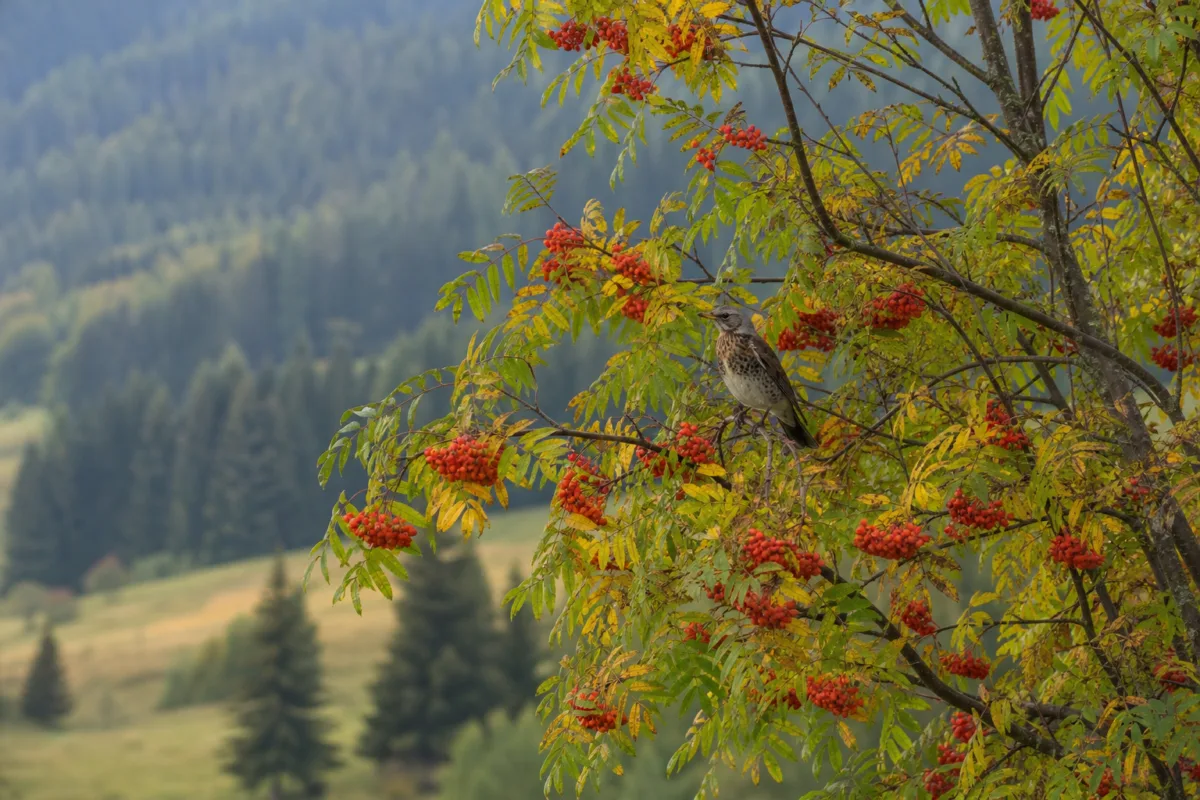
The most widespread species, familiar to everyone. It has pinnate leaves with 9–19 serrated leaflets and dark purple, felted winter buds. It usually reaches 10–15 m, exceptionally up to 20 m. The orange-red berries ripen in late summer and often stay on the tree well into winter. It grows from the lowlands right up to the treeline in the Krkonoše (Giant Mountains) and Šumava (Bohemian Forest), where it takes on a shrubby form. It tolerates acidic, nutrient-poor soils, frost and harsh mountain climates.
A speciality of the Czech landscape is the Moravian sweet rowan (Sorbus aucuparia var. edulis, syn. ‘Moravica’), a sweet-fruited form discovered in the early 19th century near the village of Spálov in the Oderské vrchy hills. Its fruit lacks the typical bitterness, and it has since been grown throughout Europe.
Service tree (Sorbus domestica)
Its leaves resemble those of rowan, but it differs in its sticky green buds, scaly pear-like bark and above all its fruit. These are pear- or apple-shaped, 2–3 cm across, yellow-green with a red blush. The service tree reaches 15–20 m and is among the longest-lived fruit trees in the country. It is considered native at most in South Moravia; elsewhere it was planted as a fruit tree. The best-known locality is the area around Strážnice and Tvarožná Lhota in the Slovácko region, where centuries-old specimens grow and a Service Tree Festival is held.
Wild service tree (Sorbus torminalis)
A warmth-loving tree with lobed leaves that at first glance resemble a maple; unlike maple leaves, however, they are arranged alternately. In autumn they turn bright red to wine-red. The fruits are brown and speckled, edible only after frost or once bletted (softened in storage). The wild service tree grows scattered in warm oak and oak-hornbeam woods, most often on calcareous or base-rich substrates. It reaches up to 25 m.
Whitebeam (Sorbus aria)
It has simple, elliptical leaves with a glossy green upper surface and a whitish felted underside, so the crown shimmers silver in the wind. The fruits are red and mealy. Whitebeam is light-demanding and drought-tolerant, growing mainly on rocky slopes and limestone; in the Czech Republic it is native only locally and is often planted in towns and villages. It usually grows to 12–15 m.
Endemic Sorbus species
Hybridisation between whitebeam, wild service tree and rowan has produced a number of species that reproduce apomictically (seeds form without fertilisation) and are therefore genetically stable. Many of them grow at just a single site in the world. Czech endemics include, for example:
- Sudeten whitebeam (Sorbus sudetica) – a shrubby species from the glacial cirques of the Krkonoše,
- Bohemian whitebeam (Sorbus bohemica) – rocky slopes of north-western and central Bohemia,
- Sorbus milensis – Milá hill in the České středohoří (Central Bohemian Uplands),
- Sorbus barrandienica – limestone slopes of the Bohemian Karst,
- Sorbus portae-bohemicae – the Porta Bohemica gorge on the Elbe,
- Sorbus hardeggensis – the Dyje (Thaya) valley in Podyjí National Park.
These species often number only tens to hundreds of individuals, so they are classed as critically or severely endangered and are protected by law.
Where Sorbus grows and its role in nature
Rowan is a typical pioneer species. Together with birch, it quickly colonises clearings, storm- and bark-beetle-damaged areas and abandoned pastures. In the mountains it is a common admixture in spruce forests and, as one of the few broadleaf trees to do so, climbs right up to the treeline. Warmth-loving species (wild service tree, whitebeam, service tree and most endemics), by contrast, inhabit sunny rocky steppes, forest-steppe and open oak woods on limestone, basalt and other nutrient-rich rocks.
The ecological importance of Sorbus is enormous:
- Rowan berries are eaten by over 60 bird species, such as thrushes, fieldfares, waxwings and bullfinches, which also disperse the seeds.
- The flowers are an important source of nectar and pollen for bees, hoverflies and beetles.
- Leaves and shoots are browsed by deer, which hampers natural regeneration where deer populations are excessive.
- Rowan leaf litter is rich in nutrients and improves acidic forest soils.
Wood and uses
Sorbus wood is hard, dense, strong and easy to work. The most valuable is that of the wild service tree and service tree: among the most expensive woods in Europe, it was used for musical instruments, turned goods, press screws, rulers and measuring instruments. Today it is used for veneers and luxury furniture. Rowan wood is less durable and is used mainly for carving and small objects.
The fruits have culinary and folk-medicine uses. Rowan berries are rich in vitamin C, carotenoids and organic acids. Raw, they are bitter and contain parasorbic acid, which irritates the digestive tract in larger amounts; cooking breaks it down. That is why they are made into jams, syrups, jellies, liqueurs and a brandy known as jeřabinka. Service tree and wild service tree fruits become sweet and mealy once bletted and are used to make the prized spirit oskorušovice. Thanks to its hardiness, rowan is also planted in land reclamation, along mountain roads and in cities.
Growing Sorbus in the garden
Sorbus species are among the most rewarding ornamental trees for smaller gardens: decorative with flowers in spring, foliage in summer, and fruit and autumn colour in autumn. They also attract birds. For an overview of other suitable species, see our article on broadleaf trees.
Site and soil
- Light: sun to partial shade; fruits most heavily in full sun.
- Soil: rowan tolerates poor, acidic and stony soils but dislikes permanent waterlogging. Whitebeam, wild service tree and service tree prefer free-draining, calcareous to neutral soils and cope well with drought.
- Climate: all native species are fully frost-hardy. Rowan struggles with hot, dry summers in lowlands and cities, where whitebeam or its cultivars are a better choice.
Planting and care
Plant bare-root trees in autumn or early spring; container-grown trees can go in at any time except during frost or extreme heat. Water during dry spells for the first two to three years and protect the trunk from browsing by hares and roe deer. Only formative and sanitary pruning is needed, ideally in late winter or summer. For fruit, plant the sweet Moravian rowan or cultivars such as ‘Konzentra’, ‘Rosina’ or the hybrids ‘Burka’ and ‘Granatnaja’. The service tree starts fruiting late, often only after 10–15 years.
Diseases and pests
- Fire blight (the bacterium Erwinia amylovora) – blackening and dieback of shoots; infected parts must be cut back well into healthy wood.
- Rusts (genus Gymnosporangium) – orange spots on leaves; juniper is the alternate host.
- Aphids and woolly aphids, sawfly and moth caterpillars, and scale insects on the trunk.
- Bark scald (sunscald) on the south side of young trunks; prevent it with shading or a protective coating.
Curiosities and cultural significance
In the folk traditions of central and northern Europe, rowan was a protective tree. Sprigs were tucked into cowsheds and above doors to ward off witches and the evil eye. The species name aucuparia comes from the Latin avis (bird) and capere (to catch): bird-catchers used rowan berries as bait. The genus name Sorbus referred to the service tree in antiquity. In times of scarcity, rowan berries were also made into flour and a coffee substitute.
The Czech Republic is exceptional for Sorbus: thanks to its varied geology and long history of hybridisation, it hosts one of the richest groups of endemic Sorbus species in Europe. Some were described only within the last two decades, so botanical research on the genus is ongoing. As with elm or yew, protecting this group has a direct impact on the biodiversity of the Czech landscape.
Summary
Sorbus is a diverse genus of the rose family, ranging from hardy mountain shrubs to massive fruit trees several centuries old. In the Czech Republic you will commonly encounter rowan with its pinnate leaves and orange berries, whitebeam, wild service tree and service tree in warmer regions, and rare endemics on select rocky outcrops. For the garden, Sorbus is an excellent choice: undemanding, ornamental all year round, and its fruit serves both people and birds.
FAQ
Are rowan berries poisonous?
Rowan berries are not poisonous, but raw they contain parasorbic acid, which irritates the stomach in larger amounts. Cooking breaks it down, which is why the berries are made into jams, syrups or liqueurs.
What is the difference between rowan and the service tree?
Both have pinnate leaves, but the service tree has sticky green buds, scaly bark and larger pear-shaped fruits 2–3 cm across. Rowan has felted purple buds, smooth bark and small orange-red berries.
When should rowan berries be picked?
Rowan berries ripen from late August to October. It is best to pick them after the first frosts, or to freeze them for a day or two before processing, which reduces their bitterness.
Which Sorbus species grow in the Czech Republic?
Rowan is common, along with whitebeam, wild service tree and service tree. There are also around twenty rare endemic species, such as Sorbus sudetica, Sorbus bohemica and Sorbus milensis.
How tall does a rowan grow?
Rowan usually reaches 10–15 m, exceptionally 20 m. Service tree and wild service tree can reach 20–25 m, while mountain and endemic species often remain shrubby.
Where does Sorbus do best in the garden?
In a sunny to partly shaded spot with free-draining soil that is not permanently waterlogged. Rowan tolerates poor acidic soils, while whitebeam and wild service tree prefer calcareous, drier sites.