Maple (Acer): Species, Identification, Distribution in the Czech Republic and Cultivation
Scientific name: Acer
Maples (Acer) are a genus of broadleaf trees and shrubs with opposite, usually palmately lobed leaves and winged fruits. The main native species in the Czech Republic are sycamore, Norway maple and field maple, with Tatarian maple occurring rarely in South Moravia.
 Tomáš Rohlena
This article was translated from Czech. Čeština
Maple (Acer) is a genus of broadleaf trees and shrubs in the soapberry family (Sapindaceae). It is easy to recognise by its opposite, mostly palmately lobed leaves and by its fruits, which form pairs of winged achenes (samaras). Once detached, they spin like little helicopters. Maples are among the most common broadleaf trees in Czech nature. They play an important role in forest ecosystems, provide valuable timber and have an irreplaceable place in parks and gardens.
At a glance
| Scientific name | Acer L. |
|---|---|
| Family | Soapberry family (Sapindaceae), formerly a separate maple family (Aceraceae) |
| Number of species | approximately 130–160, most of them in East Asia |
| Height | from shrubs to trees 35–40 m tall (sycamore) |
| Lifespan | field maple and Norway maple usually 150–250 years, sycamore up to 400–500 years |
| Leaves | opposite, long-stalked, mostly simple and palmately lobed, compound in some species |
| Flowering | April–May, yellow-green flowers in corymbs, racemes or panicles |
| Fruit | double samara: two achenes with tongue-shaped wings, ripening in September and October |
| Distribution in the Czech Republic | from lowlands to mountain areas; scree, floodplain and mixed forests, groves, avenues |
| Conservation | sycamore, Norway maple and field maple are not protected; Tatarian maple is a rare species |
How to identify a maple
The maple genus has several reliable features. They will help you tell it apart from similar trees, such as plane trees, which have alternate leaves:
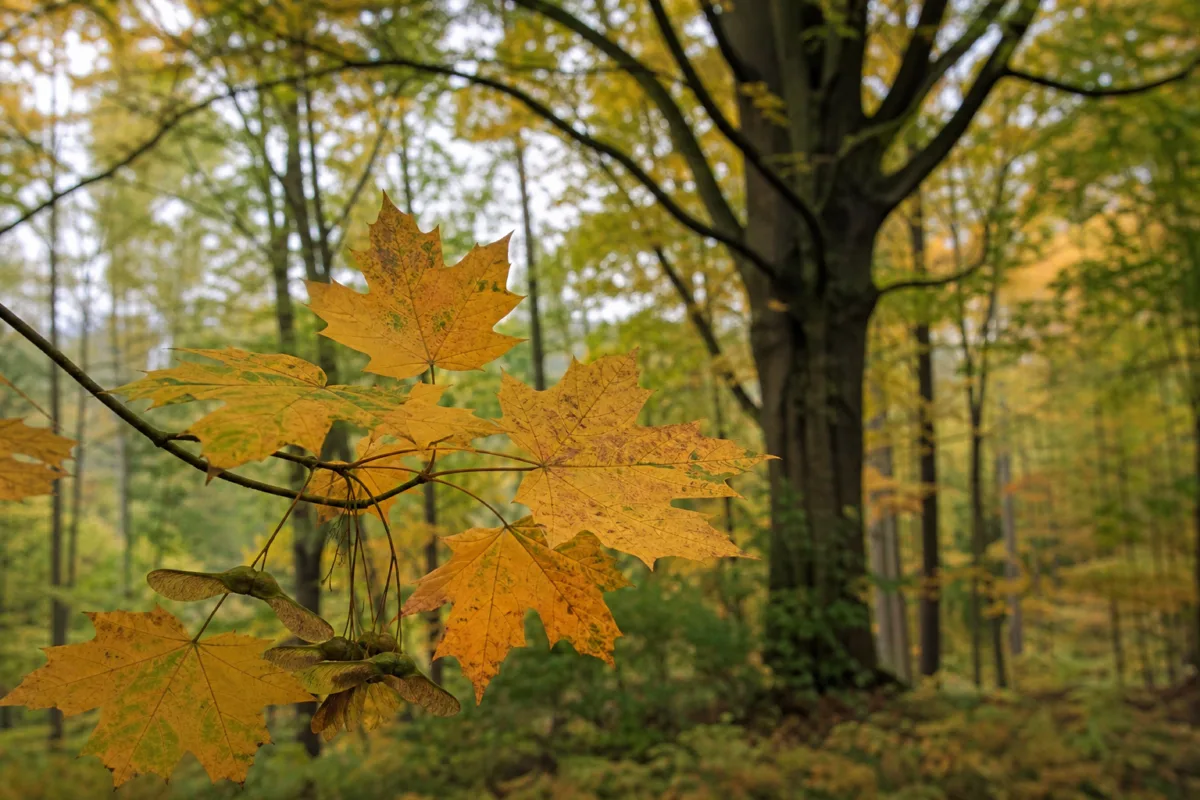
- Leaves are arranged in opposite, decussate pairs – two facing each other, with each successive pair rotated by 90°. They have a long stalk and a blade usually with 3–5 (rarely up to 13) lobes. Exceptions include box elder, which has pinnate leaves.
- Flowers are small, yellow-green or reddish, and form corymbs, racemes or panicles. They may be unisexual or bisexual and are pollinated mainly by bees and other insects. They are an important early source of nectar and pollen in spring.
- Fruits are double samaras. Each achene bears a tongue-shaped wing, and the two remain joined until ripe. The angle between the wings is one of the best identification features.
- Buds are opposite and covered with scales. Their colour helps distinguish the species in winter.
Sycamore, Norway maple or field maple?
| Feature | Sycamore | Norway maple | Field maple |
|---|---|---|---|
| Height | up to 35 (40) m | 20–30 m | usually 10–15, rarely 20 m |
| Leaf | 5-lobed, lobes bluntly toothed, greyish underside, stiffer | 5–7-lobed, lobes with long pointed teeth | small (5–10 cm), 3–5-lobed, lobes rounded |
| Milky sap in leaf stalk | no | yes, white | yes, faint |
| Inflorescence | hanging panicles after leaves unfold (May) | upright corymbs before leaves emerge (April) | upright corymbs with the leaves (May) |
| Fruit wings | at an acute to right angle | spread at an obtuse angle | spread almost horizontally |
| Bark | grey-brown, flaking in plates with age | dark, finely furrowed lengthwise, not flaking | brown, shallowly fissured, twigs often with corky ridges |
| Winter buds | green | red-brown | small, brown, hairy |
The quickest field test is simple: pick a leaf and look at the broken stalk. If white milky sap oozes out, it is a Norway maple – hence its Czech name, mléč (from mléko, milk). Sycamore has no milky sap.
Maples growing in the Czech Republic
Sycamore (Acer pseudoplatanus)
The largest and longest-lived native maple grows up to 35 m, occasionally more, and can live for 400–500 years. It is a tree of submontane and montane areas. It grows especially in scree and ravine forests, alongside lime, wych elm and ash. It reaches up to the treeline, and in the Krkonoše (Giant Mountains) and the Šumava (Bohemian Forest) it forms characteristic mountain sycamore stands. Together with spruce and beech, it is one of the most important trees of mixed mountain forests.
Norway maple (Acer platanoides)
Norway maple grows to 20–30 m and usually lives 150–250 years. It occurs from lowlands to middle elevations in scree, floodplain and mixed broadleaf forests. It is very popular in avenues and urban greenery because it tolerates city conditions better than sycamore. It is the first to catch the eye in spring: its yellow-green flowers open while the branches are still bare. In autumn its foliage turns golden yellow to orange.
Field maple (Acer campestre)
Field maple is the smallest of the common native maples. It is either a tree 10–15 m tall or a multi-stemmed shrub. It likes warmth and grows mainly in lowlands and hilly country, in oak-hornbeam woods, floodplain forests, groves and scrubby woodland edges. It tolerates pruning extremely well, which is why it is traditionally used for hedges. Young twigs often bear conspicuous corky ridges.
Tatarian maple (Acer tataricum)
This small tree or shrub with undivided or only shallowly lobed leaves is the fourth native maple of the Czech Republic. Its natural range is limited to the warmest parts of South Moravia, where it grows rarely in thermophilous oak woods and forest-steppe margins. Its fruits with strikingly red wings are a notable feature.
Non-native maples in parks and gardens
A number of exotic species are planted in parks, gardens and along roads:
- Box elder (Acer negundo) from North America has pinnate leaves. In the Czech Republic it escapes into the wild mainly in floodplains and along rivers and is considered an invasive species.
- Silver maple (Acer saccharinum) has deeply divided leaves with silvery undersides. It grows fast but has brittle branches.
- Red maple (Acer rubrum) is prized for its scarlet autumn colour.
- Japanese maple (Acer palmatum) is popular in ornamental cultivars, often with red or finely divided leaves.
- Amur maple (Acer tataricum subsp. ginnala) is a hardy shrub with fiery red autumn colour.
Ecology and importance in nature
Maples are an important admixture in forests. Their leaf litter decomposes quickly and improves the soil. Thanks to their deep, branching root systems, they stabilise slopes and scree. Early-flowering Norway maple, followed by sycamore, is a significant food source for bees in spring. Many specialised insects live on maples, and their seeds are sought out by birds and small rodents. The winged fruits are carried by the wind tens of metres from the parent tree, so sycamore and Norway maple readily spread into clearings, abandoned gardens and urban plantings.
An important practical note for horse owners: the seeds and seedlings of sycamore contain the toxin hypoglycin A, which causes atypical myopathy in horses, often fatal. Horse pastures should therefore not border fruiting sycamores.
Timber and its uses
Maple wood is pale, hard and moderately heavy (density around 600–700 kg/m³), tough and fine, with an even texture. It is easy to work and polish, does not split and does not transfer odours. Sycamore wood is the most valuable. It is used for:
- musical instruments: so-called flamed (figured) sycamore is used for the backs, ribs and necks of violins, violas and cellos, as well as parts of guitars and bassoons,
- furniture and veneers: solid furniture, marquetry, parquet flooring and staircases,
- kitchen and household utensils: chopping boards, wooden spoons, bowls and toys, as the wood is food-safe,
- woodturning and carving.
Norway maple and field maple wood is similar, only somewhat less valued. Field maple was formerly used for tool handles, pipes and small turned objects. The well-known maple syrup is made from the spring sap of North American sugar maple (Acer saccharum). Roughly 30–40 litres of sap must be boiled down to make one litre of syrup. Sap can also be tapped from Norway maple and sycamore, but it contains less sugar.
Growing maples in the garden
Choosing a species
Large species – sycamore and Norway maple – belong in parks, larger gardens and avenues. For a small garden, field maple, Tatarian maple, Amur maple or Japanese maple cultivars are suitable. Compact Norway maple cultivars are also popular, such as the globe-shaped 'Globosum' or the dark red 'Crimson King'. Sycamore has a striking cultivar, 'Brilliantissimum', with salmon-pink young leaves.
Planting, soil and light
- Position: native maples tolerate both sun and partial shade. Japanese maple needs partial shade, a sheltered spot and protection from harsh midday sun and frosty winds.
- Soil: ideally deep, fertile, moist but well-drained. Field maple tolerates even dry, chalky soil; sycamore appreciates humid air and fresh, moist, mineral-rich soils.
- Planting: best in autumn or early spring. Plant the root ball at the same depth it grew at in the nursery. Water the young tree regularly for the first two years and mulch around the trunk.
Pruning and care
In late winter and early spring maples "bleed" heavily, as sap flows from wounds. Prune them in summer (July–August) or in late autumn instead. Mature trees need only sanitary and formative pruning. Field maple hedges are trimmed once or twice a year.
Diseases and pests
- Tar spot (Rhytisma acerinum) produces black spots on leaves resembling drops of tar. It is mainly a cosmetic problem. Raking up and removing infected leaves helps.
- Powdery mildew shows as a whitish coating on leaves, more often on field maple and Norway maple.
- Verticillium wilt is a fungal disease of the vascular tissue that causes branches to die back suddenly. The only remedy is to remove affected parts.
- Sooty bark disease (Cryptostroma corticale) affects mainly sycamores after dry, hot years. The bark peels away to reveal black spore dust underneath. The spores can cause allergic pneumonitis in humans, so infected wood should be handled wearing a respirator.
- Aphids and woolly aphids produce sticky honeydew, typically under Norway maples in car parks.
Interesting facts and cultural significance
- The maple leaf is the national symbol of Canada and appears on its flag.
- In Japan, admiring autumn maple colours, known as momijigari, is as popular as spring cherry blossom viewing.
- Maple's winged fruits have inspired designers of small drones and rotors. A spinning samara falls slowly and the wind carries it far.
- The Czech folk name for field maple, babyka, probably refers to its low, "stooped" habit. The word klen (sycamore) is of Proto-Slavic origin.
- The genus Acer is very old; maple fossils are known from the Palaeogene, more than 50 million years ago.
Find out more about other native trees in our overview of broadleaf trees.
Summary
Maples are a genus of about 150 species of woody plants of the Northern Hemisphere. You can recognise them by their opposite palmate leaves and winged double samaras. Native species in the Czech Republic are sycamore, Norway maple and field maple, with Tatarian maple occurring rarely. Milky sap in the leaf stalk, the angle of the fruit wings and the bark help tell them apart. Their high-quality pale wood is used in furniture making and violin making. In the garden, maples are undemanding – just choose a species suited to the size of your plot and prune outside the spring sap flow.
FAQ
How do you tell Norway maple from sycamore?
Norway maple has leaves with sharply pointed lobes, and white milky sap oozes from the leaf stalk when it is broken. Sycamore has bluntly toothed lobes with no milky sap, a grey leaf underside, green buds and bark that flakes with age.
How many maple species grow in the Czech Republic?
Four are native: sycamore, Norway maple, field maple and, rarely in South Moravia, Tatarian maple. Many non-native species are also grown in parks and gardens, such as box elder, silver maple and Japanese maple.
When should maples be pruned?
Ideally in summer (July–August) or in late autumn. In spring maples bleed sap heavily, so pruning at that time weakens the tree unnecessarily.
Are maples poisonous?
Maples are not poisonous to people. However, sycamore seeds and seedlings contain hypoglycin A, which causes atypical myopathy in horses, often with fatal results.
Which family does the maple belong to?
Under current botanical classification (APG IV), maples belong to the soapberry family (Sapindaceae). They were formerly placed in a separate maple family (Aceraceae).
Can maple syrup be made from European maples?
Yes, sap can be tapped in spring from Norway maple and sycamore too. However, it contains less sugar than the sap of North American sugar maple, so more of it is needed to make syrup.