Beech: Identification, Species, Distribution in the Czech Republic, Wood and Cultivation
Scientific name: Fagus
Beech (Fagus) is a genus of deciduous trees in the beech family. The Czech Republic has just one native species, the European beech (Fagus sylvatica), which without human intervention would make up around 40% of the country's forests and remains the most important broadleaf tree in Czech forestry.
 Tomáš Rohlena
This article was translated from Czech. Čeština
Beech (Fagus) is a genus of large deciduous broadleaf trees in the beech family (Fagaceae), which also includes oaks and sweet chestnuts. Only one species is native to the Czech Republic: the European beech (Fagus sylvatica), recognisable by its smooth silver-grey bark, wavy glossy leaves and three-sided nuts known as beechnuts or beechmast. It is naturally the most widespread tree in Central Europe, a key species of submontane and montane forests and the source of one of the most versatile timbers.
Beech at a glance
| Scientific name | Fagus L.; in the Czech Republic Fagus sylvatica L. |
|---|---|
| Family | beech family (Fagaceae), order Fagales |
| Height | usually 25–40 m, exceptionally around 45 m |
| Lifespan | typically 200–300 years, occasionally over 400 years |
| Leaves | alternate, ovate to elliptic, 5–10 cm, entire, wavy, young leaves fringed with hairs |
| Flowering | April–May, as the leaves emerge; monoecious, wind-pollinated |
| Fruit | beechnut – a three-sided brown nut, usually in pairs within a woody, spiny cupule |
| Distribution in the Czech Republic | from the uplands to the treeline, optimum roughly 400–1,000 m above sea level |
| Protection | the species is not protected; valuable beech forests are protected in nature reserves, and the Jizera Mountains beech forests are a UNESCO World Heritage Site |
How to identify beech
Beech is one of the easiest broadleaf trees to recognise, whatever the season.
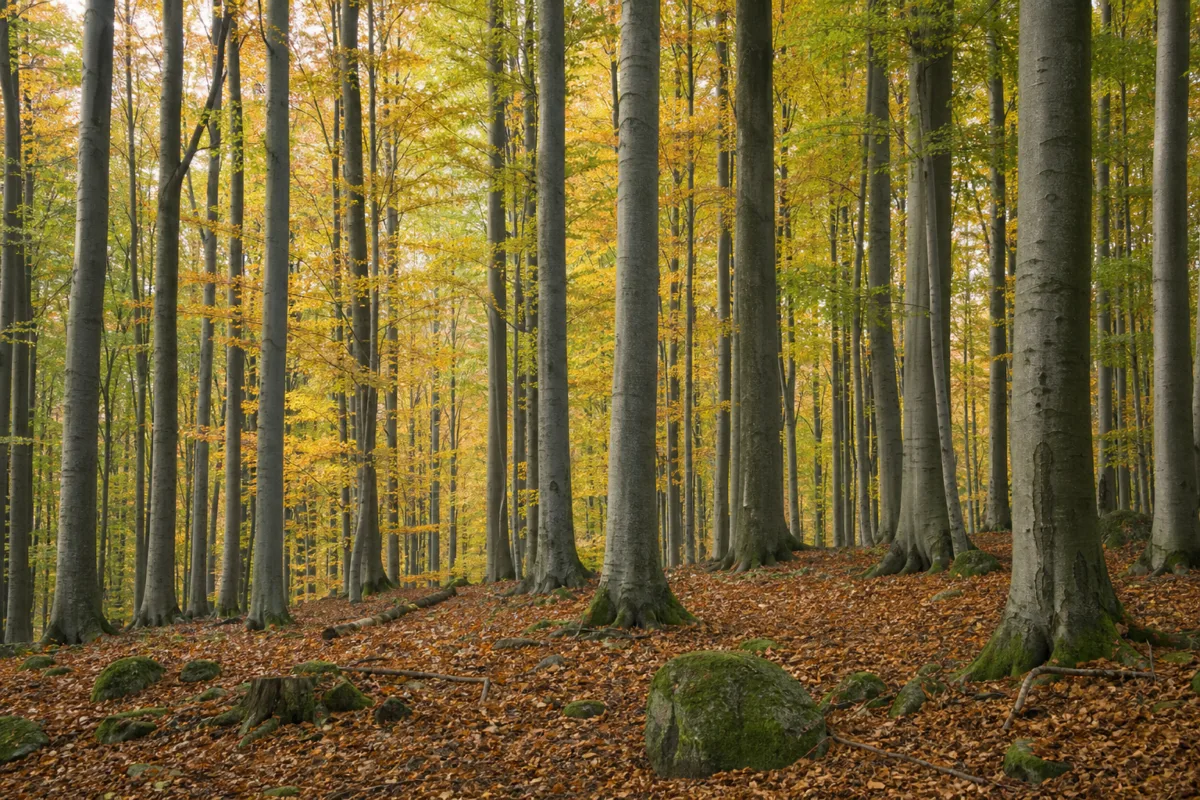
- Trunk and bark: a straight, cylindrical trunk which, in dense stands, sheds its lower branches high up. The bark stays smooth, thin and silver-grey throughout the tree's life – older trees do not develop the deeply furrowed bark of oak or lime.
- Crown: narrow and high in woodland; in the open, broadly ovoid to rounded, with branches reaching almost to the ground. The densely leaved crown lets very little light through.
- Leaves: short-stalked, ovate, with 5–9 pairs of parallel side veins. The margin is entire and slightly wavy, finely hairy on young leaves. In autumn they turn golden yellow and coppery brown.
- Buds: strikingly long (up to 2–3 cm), slender, spindle-shaped and sharply pointed, brown, held away from the twig. They make beech easy to identify even in winter.
- Fruit: beechnuts ripen in September and October. The woody, four-lobed cupule covered in soft spines splits open to release one or two glossy three-sided nuts.
- Winter foliage: young trees and hedges often keep their dry brown leaves until spring (known as marcescence).
Beech or hornbeam?
Beech is most often confused with common hornbeam (Carpinus betulus), which actually belongs to the birch family. The table summarises the differences:
| Feature | European beech | Common hornbeam |
|---|---|---|
| Leaf margin | entire, wavy | sharply double-toothed |
| Leaf surface | smooth, glossy | distinctly pleated along the veins |
| Trunk | smooth, cylindrical | smooth but fluted lengthwise, “muscular” |
| Buds | 2–3 cm, held away from twig | up to 1 cm, pressed to twig |
| Fruit | beechnut in a spiny cupule | small nut on a three-lobed bract |
Beech species
According to current classification, the genus Fagus comprises roughly 10–13 species found in the temperate zone of the Northern Hemisphere – in Europe, western Asia, eastern Asia and eastern North America. The southern “beeches” of South America and Australia (Nothofagus) form a separate family, Nothofagaceae, and are only distantly related to true beeches.
- European beech (Fagus sylvatica) – the only species native to the Czech Republic, growing from southern Scandinavia to Sicily and from Spain to Ukraine.
- Oriental beech (Fagus orientalis) – the Balkans, Asia Minor, the Caucasus and northern Iran; it has larger leaves with more pairs of veins. It is sometimes treated as a subspecies of European beech.
- American beech (Fagus grandifolia) – the only North American species, from Canada to Florida.
- Japanese beech (Fagus crenata) – Japan, the dominant tree of mountain forests.
- Other Asian species: Fagus japonica, F. engleriana, F. longipetiolata, F. lucida, F. hayatae and the Mexican F. mexicana (sometimes included in F. grandifolia).
In gardens and parks you will mostly encounter cultivars of European beech:
- Copper beeches (Atropurpurea Group, 'Atropunicea') – dark reddish-purple leaves, popular as specimen trees in chateau parks.
- 'Pendula' – weeping branches forming a “living tent”.
- 'Dawyck' – narrowly columnar, suitable even for smaller gardens; purple and yellow-leaved forms also exist.
- 'Asplenifolia' – deeply cut, fern-like leaves.
- 'Tortuosa' – a low beech with twisted, spreading branches.
Where beech grows and its ecology
European beech is a tree of oceanic and suboceanic climates. It needs adequate rainfall (roughly over 500–600 mm a year) and humid air, and does not tolerate late frosts, prolonged drought or permanent waterlogging. In the Czech Republic it thrives best in the uplands and mountains, where whole vegetation zones are named after it – the beech and fir-beech zones. In the mountains it forms mixed forests with fir, spruce and sycamore maple, and at higher altitudes it can reach the treeline, where it grows in a stunted form.
Beech is a markedly shade-tolerant tree. Seedlings can survive beneath a closed canopy for decades, waiting for a gap to open. Mature trees, in turn, shade the ground so heavily that few herbs grow beneath them – hence the typical “bare” beech woods carpeted with leaf litter, with spring ephemerals such as wood anemone, coralroot (Cardamine) or spring vetchling appearing in spring.
Beech fruits irregularly. Heavy mast years come roughly every 5–10 years, when beechnuts become an important food for wild boar, deer, dormice, wood mice, jays and nuthatches. Old and dying beeches provide cavities for woodpeckers, bats and rare beetles such as the critically endangered Rosalia longicorn.
Beech forests in the Czech Republic
Originally, beech would have made up about 40% of forests in what is now the Czech Republic; after centuries of spruce planting it now covers only about 10% of the forest area. Its share has been rising in recent years, however, as it is key to converting spruce monocultures into more resilient mixed forests. Among the most valuable sites are the Jizera Mountains beech forests (part of the UNESCO World Heritage Site “Ancient and Primeval Beech Forests of the Carpathians and Other Regions of Europe” since 2021), the Žofín Primeval Forest in the Novohradské hory mountains, the Boubín Primeval Forest, the Milešice Primeval Forest in the Šumava (Bohemian Forest), and the beech woods of the Chřiby, Beskydy and Krkonoše mountains.
Beech is also being affected by climate change. On dry, warm sites at lower altitudes it suffered extensive dieback after the drought years of 2015–2019, and foresters expect its optimum range to shift higher into the mountains.
Wood and uses
Beech wood is whitish to pinkish, with no distinctly coloured heartwood; older trees may develop a darker false heartwood. It is hard and heavy (density around 700 kg/m³ when dry), strong and easy to work, but it rots quickly outdoors without treatment and shrinks considerably when drying.
- Furniture and interiors – chairs, tables, staircases, parquet flooring. Steamed beech bends easily, the basis of the famous Thonet bentwood furniture, made since the 19th century in Moravia too (Bystřice pod Hostýnem).
- Plywood and engineered wood products, toys, kitchen utensils, tool handles.
- Railway sleepers – very durable once impregnated.
- Firewood – one of the highest-calorific woods, prized for fireplaces and smoking food.
- Chemical uses – production of pulp, viscose fibres and formerly beech tar (creosote).
Beechnuts contain up to 40% oil, which in times of hardship was pressed to make edible oil. Eaten raw in larger quantities they are mildly toxic (containing saponins and oxalic acid); roasting breaks down most of the harmful substances.
Growing beech in the garden
Beech makes an excellent specimen tree for large gardens and parks, and is one of the best plants for clipped hedges, which stay opaque even in winter thanks to their retained dry leaves.
Site and soil
- Light: tolerates partial shade and shade; when young it can be damaged by harsh sun and hot walls. Purple cultivars colour best in full sun.
- Soil: deep, humus-rich, well-drained and moist, ideally slightly acidic to neutral; it copes well with chalky soils. Heavy clay over an impermeable subsoil and waterlogged sites are unsuitable.
- Climate: needs humid air; in dry lowlands it requires watering.
Planting and care
- Plant in autumn or early spring – bare-root plants while dormant, container-grown plants later too. For a hedge, use 2–3 plants per metre.
- Do not plant the root ball deeper than it grew in the nursery, and mulch the root zone.
- Water regularly for the first 2–3 years; beech is slow to establish after transplanting.
- Trim hedges once or twice a year – at the end of June and, if needed, in August.
- Beware of exposing the trunk: the thin bark is prone to sunscald, so do not remove all the lower branches or surrounding shade from older trees at once.
- The roots are shallow and sensitive to soil compaction – do not drive machinery near the tree or raise the ground level.
Pests and diseases
- Beech gall midge (Mikiola fagi) – forms pointed reddish galls on the leaves; more a curiosity than a threat.
- Beech leaf-mining weevil (Orchestes fagi) – a tiny weevil whose larvae tunnel through the leaves.
- Woolly beech aphid (Phyllaphis fagi) – white waxy tufts on the undersides of leaves, mainly on hedges.
- Beech bark disease – a combination of the scale insect Cryptococcus fagisuga and fungi of the genus Neonectria, causing the bark to die.
- Phytophthora root and collar rot, drought-related disorders and bark sunscald; on old trees, wood-decay fungi such as the tinder fungus.
Curiosities and cultural significance
- The Germanic word for beech is related to English book and German Buch – according to tradition, runes were carved into beech tablets and the smooth bark served as a “writing surface”. Even today beech trunks are the most common victims of carved initials, and the scars remain for life.
- Many Czech place names derive from the word for beech (buk): Bukovec, Bukovina, Bukov, Buková hora and Bučovice.
- The genus name Fagus comes from the Greek phagein – to eat, referring to the edible beechnuts.
- In the mountains, beech can form both 40-metre giants and metre-high shrubs twisted by wind and snow.
- Many mighty beeches are listed as memorial trees in the Czech Republic, and numerous copper beeches in chateau parks are over 200 years old.
Summary
European beech is a tree that largely shapes the character of the Central European landscape. You can recognise it by its smooth grey bark, wavy glossy leaves, long pointed buds and beechnuts. It is shade-tolerant and needs a moister climate and well-aerated soil, which is precisely why it is key to restoring more natural mixed forests. Its hard yet bendable wood is used for everything from furniture to firewood, and in the garden it shines both as a majestic specimen tree and as a dense hedge.
FAQ
How can I tell beech from hornbeam?
Beech has entire, slightly wavy, glossy leaves and a smooth cylindrical trunk, whereas hornbeam has sharply toothed, pleated leaves and a trunk fluted lengthwise. Another reliable feature is beech's long (up to 3 cm) pointed buds.
Are beechnuts edible?
Yes, but raw beechnuts contain saponins and oxalic acid, so in larger amounts they can cause digestive upset. It is safer to eat them in small quantities and roasted.
How long does European beech live?
Typically 200 to 300 years, exceptionally over 400 years. It starts producing nuts at around 40–60 years of age, or later in closed stands.
Is beech wood hard?
Yes, beech is a hard, heavy wood with a density of around 700 kg/m³. It is strong, easy to work and bends well after steaming, but rots quickly outdoors without protection.
Why doesn't beech drop its leaves in winter?
Young beeches and clipped hedges often keep their dry brown leaves until spring. This is called marcescence: the leaves do not fully detach from the branches and only fall when new ones emerge.
When and how should I trim a beech hedge?
Ideally at the end of June, once spring growth has finished, with an optional second trim in August. Shape the hedge so it tapers slightly towards the top, so that the lower part also gets enough light.