Spruce (Picea): Identification, Species, Distribution in the Czech Republic and Cultivation
Scientific name: Picea
Spruce (Picea) is a genus of conifers in the pine family with about 35–40 species across the Northern Hemisphere. Only Norway spruce (Picea abies) is native to the Czech Republic, where it now makes up roughly half of all forests.
 Tomáš Rohlena
This article was translated from Czech. Čeština
Spruce (Picea) is a genus of evergreen conifers in the pine family (Pinaceae), comprising roughly 35–40 species found in the temperate and cold zones of the Northern Hemisphere. Only one species is native to the Czech Republic: Norway spruce (Picea abies). Thanks to forestry practices, it now covers about half of the country's forest area and is its most economically important tree. You can recognise it by its hanging cones, which fall off whole, and by its rough twigs studded with pegs left behind by fallen needles.
Norway spruce at a glance
| Scientific name | Picea abies (L.) H. Karst. (formerly Picea excelsa) |
|---|---|
| Family | pine family (Pinaceae) |
| Height | usually 30–40 m, exceptionally over 50 m |
| Lifespan | typically 200–300 years, rarely up to 400–500 years |
| Needles | 1–2.5 cm, four-sided, stiff, pointed, borne singly on woody pegs |
| Flowering | May–June, monoecious, wind-pollinated |
| Fruit | hanging cylindrical cone 10–16 cm long, ripens in the autumn of its first year, falls whole |
| Distribution in the Czech Republic | naturally in mountains, waterlogged sites and frost hollows; planted almost everywhere |
| Conservation status | not protected or threatened |
How to identify spruce
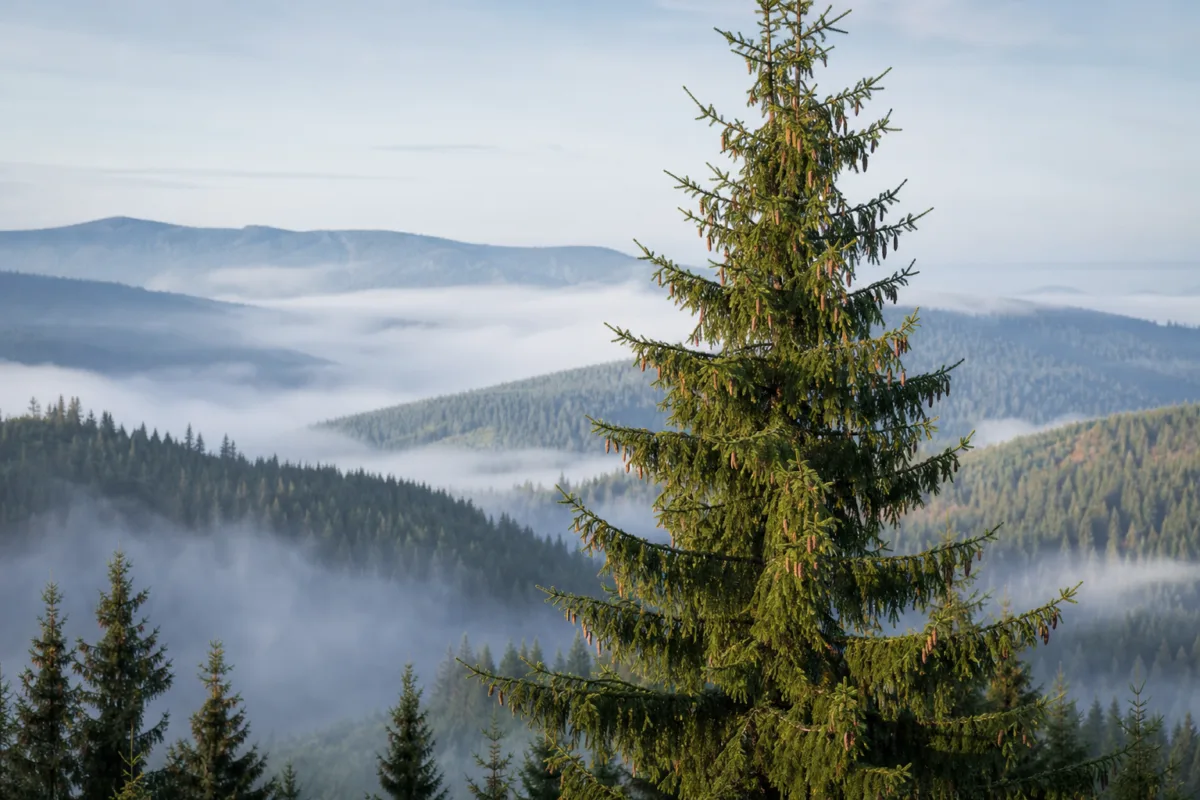
Spruce is one of the conifers with a regular, narrowly conical crown and a single continuous trunk. Its branches grow in whorls – one tier each year – so on young trees you can roughly estimate age by counting the whorls.
Needles
Norway spruce needles are four-sided (diamond-shaped in cross-section), stiff and prickly, with pale stomatal lines on all four sides. They grow singly in a spiral around the twig, each seated on a tiny woody projection called a peg (sterigma). When the needles fall, the pegs remain, leaving the twig as rough as a grater – the most reliable identification feature. Some exotic species, such as Serbian spruce and Sitka spruce, have flattened needles. Each needle has a single vascular bundle and usually stays on the tree for 5–7 years, longer in the mountains.
Cones
Spruce cones always hang downwards and, once the seeds have been shed, fall off whole. They consist of woody scales arranged in a spiral. In Norway spruce they are 10–16 cm long, green or purple at first and brown when ripe. Beneath forest spruces you will therefore find whole cones, often gnawed by squirrels or picked apart by crossbills.
Bark and flowers
The bark is thin and reddish-brown at first, later turning grey-brown and flaking off in thin, rounded scales. Spruce is monoecious: the male cones are strawberry-red to yellow and release pollen in May, while the female cones start out upright and strikingly crimson, turning downwards only after pollination.
Spruce or fir?
Spruce is most often confused with fir. The table summarises the differences:
| Feature | Spruce | Fir |
|---|---|---|
| Needles | four-sided, prickly, all around the twig | flat, blunt, with two white bands underneath, often in two rows |
| Twig after needle fall | rough, with pegs | smooth, with round scars |
| Cones | hanging, fall whole | upright, disintegrate on the tree |
| Bark | reddish-brown, scaly | greyish-white, smooth for a long time |
You can reliably tell spruce from pine and larch because its needles grow singly rather than in bundles.
Spruce species in the Czech Republic
Only Norway spruce is native. In parks, gardens, ornamental plantings and forest plantations, however, you will come across a number of exotic species:
- Blue spruce (Picea pungens) – from the Rocky Mountains in the USA; very hard, sharply prickly needles, strikingly silvery blue in cultivars of the Glauca group. Widely planted on housing estates and in gardens, and in the past also as a substitute tree in the Ore Mountains (Krušné hory), which were damaged by air pollution.
- Serbian spruce (Picea omorika) – a Balkan endemic from the Drina river basin; a very slender, columnar crown and flat needles with two white bands. Tolerates polluted air well and is popular in towns.
- White spruce (Picea glauca) – from North America; best known for its dwarf cultivar 'Conica' with a dense conical crown.
- Oriental spruce (Picea orientalis) – from the Caucasus and north-eastern Turkey; the shortest needles of any spruce (6–10 mm), glossy and blunt.
- Sitka spruce (Picea sitchensis) – from the Pacific coast of North America; the world's largest spruce (over 90 m), rare in the Czech Republic as it needs a humid climate.
- Engelmann spruce (Picea engelmannii) and black spruce (Picea mariana) – found mainly in arboreta and collections.
Norway spruce also has many garden cultivars: the rounded, nest-shaped 'Nidiformis', the weeping 'Inversa', 'Acrocona', which bears cones even on young plants, and the dwarf 'Little Gem'.
Where spruce grows and its ecology
Norway spruce is native to northern and central Europe, from Scandinavia through the Carpathians and the Alps to the Balkans. In the Czech Republic, natural spruce forests occur mainly at the highest mountain elevations – in the Šumava (Bohemian Forest), the Krkonoše (Giant Mountains), Hrubý Jeseník, Králický Sněžník and the Beskydy – roughly above 1,100–1,200 m above sea level, where spruce forms the upper treeline. Smaller natural populations also grow on peat bogs, in waterlogged hollows and in cold gorges with temperature inversions, such as the sandstone ravines of Bohemian Switzerland (České Švýcarsko).
At lower elevations, spruce was originally only a minor component of montane fir-beech forests alongside beech and fir. Its natural share of the forests is estimated at just around 11%. From the late 18th century onwards, however, its fast growth, ease of cultivation and high-quality timber led to it being planted in even-aged monocultures even in hilly country and lowlands, so that today it makes up about half of all forests.
Drought and bark beetles
Spruce has a shallow, plate-like root system and needs a moist, cool climate with annual rainfall above roughly 700 mm. In warmer areas it is therefore vulnerable to drought and windthrow. Weakened trees are attacked by the European spruce bark beetle (Ips typographus), whose population explosion after the dry years of 2015–2020 caused the largest bark beetle outbreak in the history of Czech forestry, especially in the Vysočina region, Moravia and Central Bohemia. Foresters are therefore converting spruce monocultures at lower elevations into mixed forests with beech, fir, oak and other species.
Ecologically, spruce is important for many animals: its seeds feed common crossbills, squirrels and woodpeckers, while montane spruce forests are home to the western capercaillie, the Eurasian pygmy owl and the three-toed woodpecker. Many specialised fungi live in its litter, such as the king bolete.
Timber and uses
Spruce wood is soft, light (density approximately 430–470 kg/m³) and pale to yellowish-white, with a lustrous surface and little visible difference between sapwood and heartwood. It is easy to work, glues well and is very strong for its weight. It is used:
- in construction for roof trusses, beams, boards, glulam beams and timber-frame buildings,
- in furniture making, packaging and pallets,
- to make pulp, paper, chipboard and fibreboard,
- as tonewood for the soundboards of violins, guitars and pianos – the most prized is slow-grown mountain wood with narrow, even growth rings, such as that from the Šumava and the Krkonoše,
- as Christmas trees and a source of evergreen boughs.
Resin was formerly used to make rosin and turpentine, and the bark supplied tannins for leather tanning. In folk medicine, young shoots are used to make a cough syrup.
Growing spruce in the garden
Position and soil
Spruces like sun to partial shade, humid air and moist, slightly acidic to neutral soil. They do not tolerate prolonged drought, heat or compacted soil. For warm lowlands and smaller gardens, the hardier Serbian spruce or blue spruce is a better choice than Norway spruce, which grows too large when mature to be planted near houses – its shallow roots and large crown make it a hazard in storms.
Planting and care
- Plant in spring or early autumn, ideally root-balled or container-grown plants.
- Dig a planting hole about twice as wide as the root ball and do not plant the tree deeper than it was growing before.
- In the first few years and during dry spells, water deeply but less often; a mulch of bark or needles helps.
- Pruning is not necessary; spruce hedges can be trimmed in late June. Spruce does not resprout from old wood, so never cut branches back into the bare section.
- Protect dwarf cultivars such as 'Conica' from direct sun and frost in late winter, which cause the needles to turn brown.
Pests and diseases
The most common garden pest is the green spruce aphid (Elatobium abietinum), which after mild winters causes older needles to yellow and drop, especially on blue spruce. Adelgids (genera Adelges, Sacchiphantes) form cone-like galls on shoots. In dry weather, spruce spider mites multiply. Roots and trunks are attacked by honey fungus and root rot fungus (Heterobasidion annosum), which cause decay. The best prevention is a suitable site and sufficient moisture.
Interesting facts and cultural significance
- In Sweden's Fulufjället mountains grows a spruce known as Old Tjikko. Its visible trunk is young, but its root system has been regenerating clonally for around 9,500 years, making it one of the oldest known organisms.
- The Czech epithet 'ztepilý' means slender and tall. The older scientific name Picea excelsa ('lofty') has been replaced by the valid name Picea abies.
- Spruce is the most popular Christmas tree in the Czech Republic and has been a symbol of Christmas in central Europe since the 19th century.
- Scientists use the growth rings of mountain spruces to reconstruct the climate of past centuries.
- In the Šumava, stands attacked by bark beetles in non-intervention zones are left to develop naturally; today a new, more diverse forest is regenerating there on its own.
Summary
Spruce is a genus of about 35–40 conifer species, represented in the Czech Republic by a single native species – Norway spruce. You can reliably identify it by its four-sided, prickly needles on pegs and its hanging cones that fall whole. It is a key tree of mountain forests and the most important source of timber, yet also a symbol of the necessary transformation of monocultures into more diverse mixed forests that are more resilient to drought and bark beetles.
FAQ
How can I tell spruce from fir?
Spruce has four-sided, prickly needles on woody pegs and hanging cones that fall whole. Fir has flat, blunt needles with white bands underneath and upright cones that disintegrate on the tree.
How tall and how old can Norway spruce grow?
Norway spruce usually reaches 30–40 metres, exceptionally over 50 metres. It typically lives 200–300 years, rarely up to around 500 years.
How many spruce species grow in the Czech Republic?
Only Norway spruce (Picea abies) is native. Non-native species are also planted, most commonly blue spruce, Serbian spruce, white spruce and Oriental spruce.
Why are so many spruces dying in the Czech Republic?
Spruce was planted on a massive scale even in warm, dry lowland areas where the climate does not suit it. Drought-weakened trees are then attacked en masse by the European spruce bark beetle, leading to an extensive bark beetle outbreak.
What is spruce wood used for?
Spruce wood is light, soft and strong, so it is used in construction, furniture, paper and wood-based panels. High-quality mountain wood serves as tonewood for violins, guitars and pianos.
Is spruce a good tree for the garden?
Norway spruce grows very large and has shallow roots, so it is unsuitable for smaller gardens. Dwarf cultivars or the hardier Serbian spruce and blue spruce are better choices.