Larch: the conifer that sheds its needles for winter
Scientific name: Larix
Larch (Larix) is a genus of deciduous conifers in the pine family. Only the European larch is native to the Czech Republic; it turns golden in autumn before shedding its needles, and its durable, resinous wood is among the most resilient in Central Europe.
 Tomáš Rohlena
This article was translated from Czech. Čeština
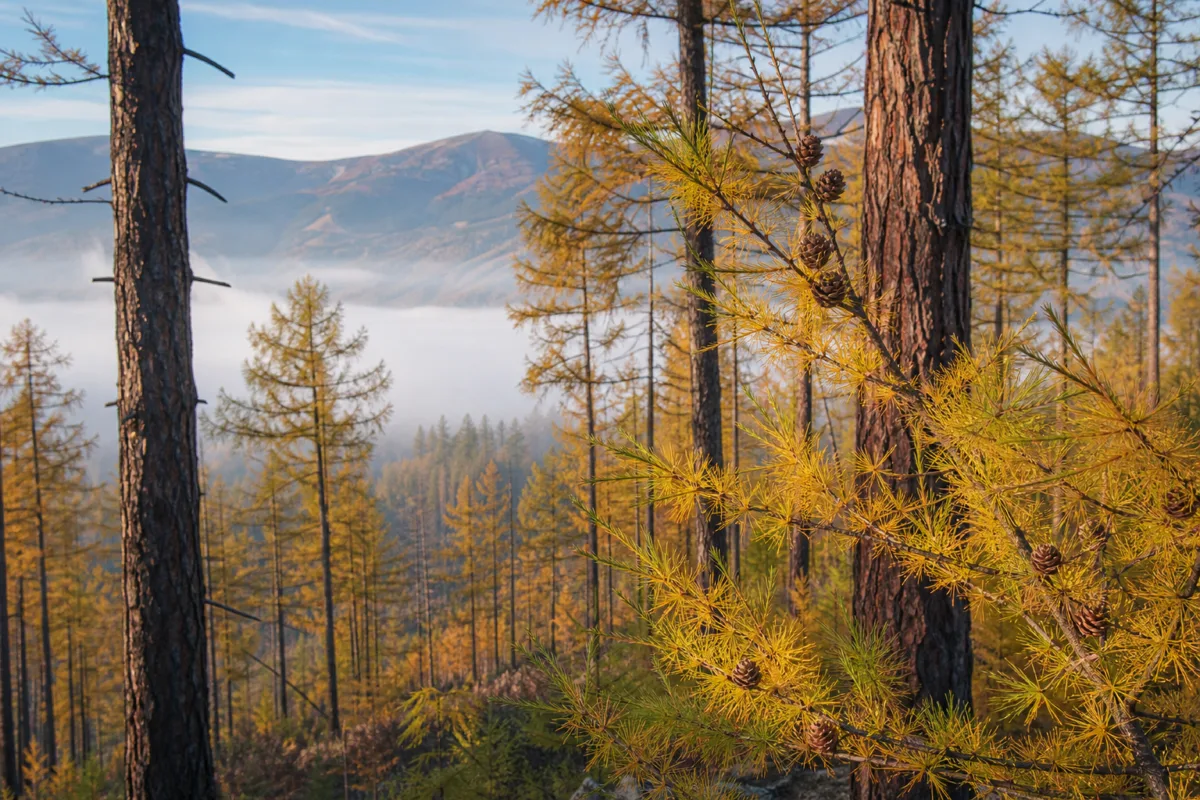
Larch (Larix) is a genus of coniferous trees in the pine family (Pinaceae) and one of the few conifers that shed their needles for winter. Only one species is native to the Czech Republic, the European larch (Larix decidua). Yet it can be found in almost every forest, because it has been planted for centuries thanks to its fast growth and exceptionally durable wood. In autumn, larches turn the woods golden yellow, and in spring they are among the first trees to green up.
Larch at a glance
| Scientific name | Larix Mill.; native to the Czech Republic: Larix decidua Mill. |
|---|---|
| Family | pine family (Pinaceae) |
| Number of species | approximately 10–14 (depending on taxonomic treatment) |
| Height | European larch typically 25–40 m, exceptionally over 45 m; the genus as a whole roughly 15–50 m |
| Lifespan | usually 200–400 years; individuals over 800 years old are documented in the Alps |
| Needles | soft, 1.5–4 cm long, light green, turning golden yellow and falling in autumn |
| Flowering | March–May, at the same time as the needles emerge |
| Fruit | upright cones 2–4 cm long, ripening in the autumn of the first year and staying on the tree for many years |
| Distribution in the Czech Republic | native to the Jeseníky and Nízký Jeseník mountains; planted throughout the country from lowlands to mountains |
| Protection | not legally protected; native populations of Sudeten larch are a valuable genetic resource |
How to identify larch
Among conifers, larch is unmistakable, especially in winter, when it stands bare with only cones on its branches. Other native conifers such as spruce, fir and pine stay green all year round.
Needles and shoots
A typical feature is the presence of two kinds of shoots. On long shoots (current-year growth), needles grow singly in a spiral. On short shoots (brachyblasts), the shortened side spurs, they form dense clusters of 20–40 needles. The needles are thin, soft and not prickly, fresh light green in spring, darker in summer and golden yellow in autumn (October to November). Then they fall, leaving only small wart-like bumps on the short shoots.
Crown, trunk and bark
The trunk is usually straight and continuous; the crown is narrowly conical in young trees, becoming sparser and irregular with age. The main branches are rather horizontal or slightly ascending, while the side branchlets often hang down. The bark of young trees is smooth and greyish. With age it turns into thick, deeply fissured bark that is reddish brown inside the cracks.
Flowers and cones
Larch is monoecious: male and female cones are borne on the same tree. Male cones are small, yellowish and point downwards. Female cones are upright and strikingly pink to purplish red, popularly known in Czech as larch roses. They are wind-pollinated. The cones ripen in the autumn of the same year; they are ovoid, 2–4 cm long and remain upright. The winged seeds fall out over winter and spring, but the empty cones stay on the branches for several more years.
Larch species in the Czech Republic
The genus Larix comprises roughly ten to fourteen species found in the cooler temperate and boreal zones of the Northern Hemisphere, from the Alps through Siberia to Canada. Only the European larch is native to the Czech Republic, but other species and hybrids are grown in forests, parks and arboretums.
| Species | Origin | Identifying features | Occurrence in the Czech Republic |
|---|---|---|---|
| European larch (Larix decidua) | Alps, Carpathians, Sudetes, Poland | yellowish shoots; cone scales straight or only slightly wavy | native and widely planted |
| Japanese larch (Larix kaempferi) | Japan (Honshu) | reddish-brown shoots with a waxy bloom; blue-green needles; cone scales curved outwards, cone resembles a small rose | forest plantings, parks |
| Hybrid larch (Larix × marschlinsii, syn. L. × eurolepis) | hybrid of European and Japanese larch | intermediate features, very fast growth | forestry plantings |
| Siberian larch (Larix sibirica) | Russia, western and central Siberia | cones with downy scales; comes into leaf very early | arboretums, rare |
| Tamarack (Larix laricina) | Canada, northern USA | small cones up to 2 cm, short needles | collections and parks |
Sudeten larch
The native populations in the Hrubý and Nízký Jeseník mountains and the adjacent part of Poland are often referred to as Sudeten larch (Larix decidua subsp. sudetica, sometimes treated only as a variety). It differs from Alpine larches in its smaller cones and excellent, straight growth form, which is why foresters value it as a source of high-quality seed. The classic locality is the area around Rýmařov, Bruntál and the upper Moravice valley.
Habitat and ecological role
Larch is a markedly light-demanding pioneer species. It does not regenerate in the shade of other trees and persists in closed-canopy forest only where it overtops the surrounding stand. In the wild it colonises clearings, landslides and the upper treeline. In the Alps it climbs to over 2,000 m above sea level, often forming open larch and larch–Swiss stone pine woodland. It tolerates severe frost but dislikes the humid, warm air of the lowlands, late frosts after bud burst and permanently waterlogged soil.
Siberian species make up some of the most extensive forests on the planet. Dahurian larch (Larix gmelinii) grows on the Taymyr Peninsula at around 72° north, the northernmost of any tree in the world. Shedding needles is precisely an adaptation to extremely long, dry, frosty winters, during which evergreen needles would lose water.
Larch accounts for about 4% of the forested area in the Czech Republic. It is mostly grown in mixtures with spruce, beech or pine. Its deep, heart-shaped root system makes it resistant to windthrow and good at stabilising soil. Its needle litter decomposes faster than spruce litter and acidifies the soil less. The open crown lets light through, so larch stands often have a rich herb layer.
Larch lives in close mycorrhizal symbiosis with fungi. The best known is the larch bolete (Suillus grevillei), which grows almost exclusively under larches, along with the grey larch bolete (Suillus viscidus) and other species. Larch seeds provide food for crossbills, siskins and squirrels.
Wood and uses
Larch wood is among the finest and most durable coniferous timbers in Central Europe. The narrow sapwood is yellowish, while the heartwood is distinctly reddish brown with conspicuous growth rings. The wood is heavy (density around 550–600 kg/m³), strong and elastic, and thanks to its high resin content it is resistant to moisture and rot. In water and in permanent contact with moisture it lasts for decades.
- Water structures: piles, weirs, bridges, boats and jetties. Larch piles support, among other things, parts of historic Venice.
- Mine supports: larch was once used extensively in mines because it "warns" of failure by creaking before it breaks.
- Construction: cladding, decking, shingles, windows, doors, roof trusses and log cabins.
- Furniture and interiors: flooring, staircases, panelling and garden furniture.
- Resin: used to produce Venice turpentine, employed in medicine, veterinary practice and the manufacture of varnishes and artists' paints.
Drawbacks include the wood's tendency to split and its higher resin content, which can bleed out and complicate surface finishing. Outdoor larch elements are therefore often left untreated. Over time they weather naturally to grey while retaining their strength.
Growing larch in the garden
Larch is a rewarding tree for large gardens, parks and the wider landscape. It offers fresh spring greenery, lovely autumn colour and a winter silhouette dotted with cones. Given its eventual size, however, dwarf cultivars are better suited to small gardens.
Site and soil
- Light: full sun; in shade it declines and loses its shape.
- Soil: deep, well-drained and moderately moist. European larch tolerates even chalky soils, while Japanese larch prefers slightly acidic ones.
- What to avoid: waterlogged and compacted soils, frost hollows and overly dry, warm sites.
Planting and care
Bare-root saplings are best planted in autumn after the needles drop or in early spring before bud burst. Larch comes into leaf very early, so don't delay spring planting. Container-grown plants can be planted throughout the season as long as they are watered. Young trees grow quickly, up to 50–100 cm a year. For the first two years it is important to water them during dry spells and keep a weed-free circle or mulch around them. Pruning is usually unnecessary, as larch develops its natural shape on its own. Any removal of dead or crossing branches should be done in winter, when the tree is bare.
Recommended cultivars
- Larix decidua ‘Pendula’: weeping branches, ideal as a specimen tree.
- Larix decidua ‘Repens’: prostrate habit, often top-grafted onto a stem.
- Larix kaempferi ‘Blue Dwarf’: dwarf, rounded shrub with blue-green needles.
- Larix kaempferi ‘Diana’: spirally twisted branchlets.
Larch is also a popular species for bonsai. It tolerates cutting back well, produces small needles, and its seasonal changes stand out even in miniature.
Diseases and pests
- Larch canker (Lachnellula willkommii): a fungus causing sunken, resin-filled wounds on branches and the trunk. Trees on damp, foggy sites suffer most.
- Larch case-bearer (Coleophora laricella): a tiny moth whose caterpillars mine the needles, which then turn white as if scorched by frost.
- Larch bud moth (Zeiraphera griseana): during outbreaks it can defoliate extensive stands, especially in the mountains.
- Adelgids (genus Adelges): aphid-like insects that produce white woolly tufts on the needles.
A healthy tree on a suitable site will survive most infestations without serious consequences. The best prevention is plenty of light and an airy, well-drained position.
Interesting facts
- Together with the dawn redwood and the bald cypress, larch is one of the few conifers that regularly shed their needles. In the Czech Republic it is the only native conifer to do so.
- The genus name Larix was already used by Roman authors. Vitruvius described larch wood as fire-resistant, which is, however, an exaggeration.
- In Alpine folk tradition, larch was believed to protect against evil forces and lightning.
- Larch wood yields arabinogalactan, a substance used in the food industry and in dietary supplements.
- Thanks to their golden autumn colour, larch stands are among the most photogenic autumn scenes in the Czech mountains.
Summary
Larch is a light-loving, fast-growing conifer of the pine family and the only native Czech conifer to shed its needles for winter. The European larch is native to the Czech Republic, with a valuable Sudeten population in the Jeseníky mountains. It is, however, planted all over the country, and in forests and gardens it is joined by Japanese and hybrid larch. Its reddish-brown, resinous wood is among the most durable of all, which is why it has long been used for water structures, cladding and decking. In the garden it mainly needs sun and plenty of space, and in return it rewards you with fresh spring greenery and a golden autumn.
FAQ
Why does larch lose its needles in winter?
Shedding needles is an adaptation to long, harsh winters. Without needles, the tree does not lose water at a time when it cannot draw any from frozen soil, and in spring it grows a fresh set.
Is larch a conifer or a broadleaf tree?
Larch is a conifer in the pine family. Although it sheds its needles for winter like broadleaf trees, it has needles, cones and the gymnosperm reproduction typical of conifers.
Which larch grows in the Czech Republic?
Only the European larch (Larix decidua) is native, occurring naturally mainly in the Hrubý and Nízký Jeseník mountains. Japanese and hybrid larch are also planted in forests and parks, and other species grow in arboretums.
How long does larch decking or cladding last?
Good-quality larch heartwood typically lasts 15–25 years outdoors without chemical treatment, and even longer with good design and ventilation. Left unfinished, it turns grey over time but keeps its strength.
Is larch suitable for a small garden?
The common European larch reaches 25–40 m, so it is not suitable for a small garden. Dwarf or weeping cultivars such as ‘Blue Dwarf’ or ‘Pendula’ are better for smaller spaces.
How can I tell European larch from Japanese larch?
European larch has yellowish shoots and cones with straight scales. Japanese larch has reddish-brown shoots, bluer-green needles and cone scales curved outwards, so the cone resembles a small rose.