Poplar: Species, Identification, Distribution in the Czech Republic and Cultivation
Scientific name: Populus
Poplar (Populus) is a genus of fast-growing dioecious trees in the willow family. Black poplar, white poplar and aspen are native to the Czech Republic, along with grey poplar, their natural hybrid, and a range of planted hybrids.
 Tomáš Rohlena
This article was translated from Czech. Čeština
Poplar (Populus) is a genus of fast-growing broadleaf trees in the willow family (Salicaceae), found across the temperate and partly subtropical zones of the Northern Hemisphere. Three species are native to the Czech Republic – black poplar, white poplar and aspen – together with their natural hybrid, grey poplar. Poplars are among the most important trees of floodplain forests and riverside woodland, and their light, soft timber is still used in industry and for growing biomass.
Poplar at a glance
| Scientific name | Populus L. |
|---|---|
| Family | willow family (Salicaceae), order Malpighiales |
| Number of species | roughly 30–40 species (depending on the classification), plus numerous hybrids and cultivars |
| Height | usually 15–35 m, occasionally over 40 m |
| Lifespan | aspen usually up to 100 years, black and white poplar 150–300 years, hybrid poplars often only 50–80 years |
| Leaves | alternate, deciduous, long-stalked; triangular, diamond-shaped, rounded to lobed |
| Flowering | March–April, before the leaves emerge; dioecious, wind-pollinated catkins |
| Fruit | a capsule splitting into 2–4 valves; tiny seeds with white fluff |
| Occurrence in the Czech Republic | floodplain forests and riverbanks (black and white poplar), woodland edges, clearings and glades (aspen) |
| Protection | the genus is not legally protected; native black poplar is listed as endangered in the Red List of vascular plants of the Czech Republic |
How to identify a poplar
Poplars are typically tall trees with a spreading or narrow crown that grow very quickly – young trees can put on 1–2 m a year. They are broadleaf trees best recognised by a combination of their leaves, buds and flowers.
- Leaves are alternate with a strikingly long stalk. In aspen and black poplar the stalk is flattened sideways, so the leaf blade trembles in even the slightest breeze.
- Buds are covered by several scales (unlike willow, which has just one), and in many species they are sticky and smell of resin.
- Flowers lack petals and are clustered in drooping catkins. Poplars are dioecious – male and female catkins grow on separate trees. Male catkins are reddish from their anthers, female ones greenish.
- The fruit is a capsule that splits open in May to June, releasing tiny seeds equipped with fluff. This is the source of the familiar “poplar snow”.
- The bark of young trees is smooth and grey to greenish, later becoming deeply fissured (black poplar) or dark and furrowed near the base (white poplar, aspen).
Poplar species in the Czech Republic
Black poplar (Populus nigra)
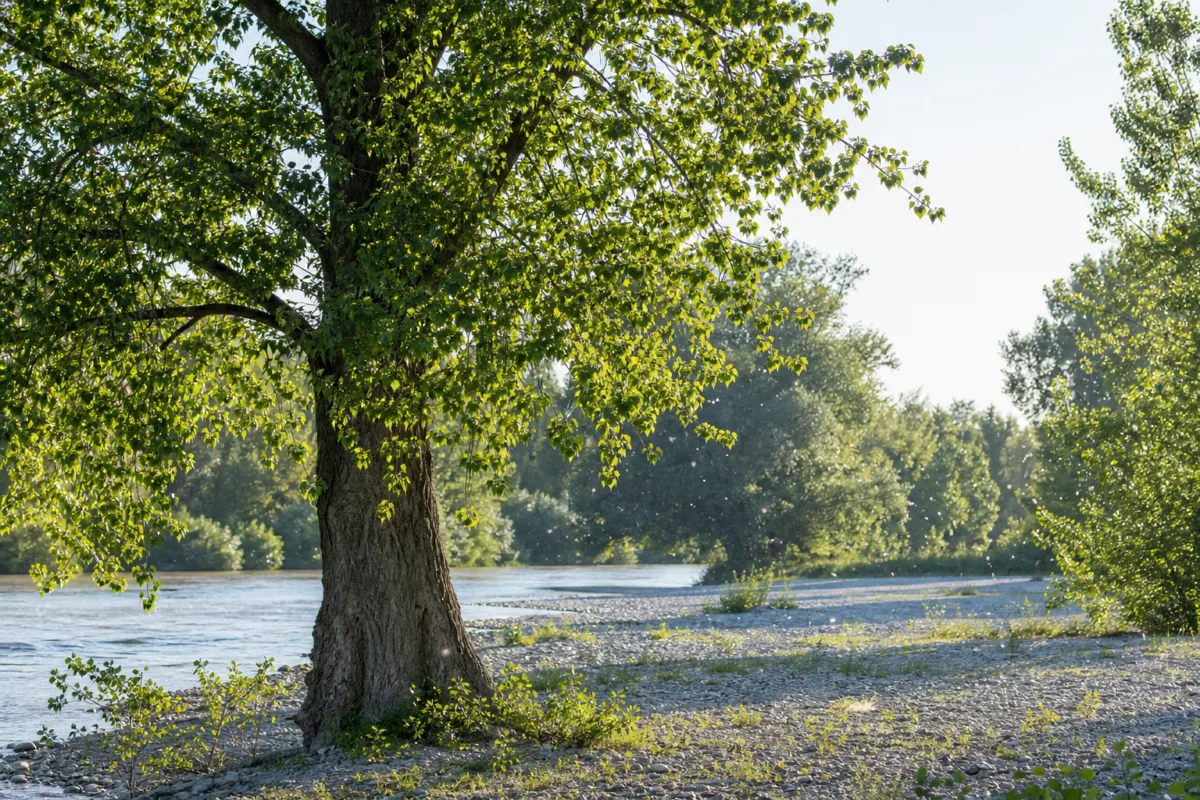
A massive tree reaching 25–35 m with a broad, irregular crown. The leaves are triangular to diamond-shaped, hairless and finely toothed. Older trunks often develop bulges and burrs. Its typical habitat is gravel and sand bars along rivers. Native black poplar is now rare: natural regeneration requires open river deposits, which have all but disappeared after river channelisation, and the species also hybridises with planted hybrid poplars. Its columnar male cultivar, the Lombardy poplar (Populus nigra 'Italica'), is widely planted in avenues and along roads.
White poplar (Populus alba)
A tree 20–30 m tall, easily recognised by the white, felted undersides of its leaves and the whitish bark of young branches. Leaves on long shoots are palmately 3–5-lobed and resemble maple leaves; those on short shoots are ovate and toothed. It grows mainly in warm lowlands, in the floodplain forests of South Moravia and the Elbe lowlands (Polabí). It spreads vigorously by root suckers.
Aspen (Populus tremula)
The smallest and most widespread of the native poplars, usually 15–25 m tall. It has almost round leaves with wavy-toothed margins and a long, flattened stalk that makes them quiver – hence the Czech saying “to shake like an aspen leaf”. It is a pioneer species that, together with birch, quickly colonises clearings, quarries, spoil heaps and woodland edges from the lowlands up to the mountains. In autumn it turns golden yellow to orange.
Grey poplar (Populus × canescens)
A natural hybrid of white poplar and aspen. The leaves are greyish-felted beneath, less markedly than in white poplar, and have rather wavy-toothed margins. It grows alongside its parents in lowland floodplains.
Planted and non-native poplars
Non-native species and hybrids are widely grown in the countryside, parks and along roads:
- Canadian poplar (Populus × canadensis) – a hybrid of black poplar and the North American eastern cottonwood (P. deltoides), the most commonly planted “commercial” poplar, with a straight trunk and broad crown;
- balsam poplar (P. balsamifera) and black cottonwood (P. trichocarpa) – North American species with sticky, strongly fragrant buds and whitish leaf undersides;
- Chinese poplar (P. simonii) – an East Asian species with small diamond-shaped leaves, planted in parks;
- modern clones for energy plantations (e.g. P. maximowiczii × P. nigra hybrids), harvested on rotations of a few years.
Where poplars grow and their ecology
The genus Populus evolved on moist, nutrient-rich, open sites. Most species are light-demanding, tolerate short-term flooding and need plenty of water. Seeds are produced in enormous numbers but remain viable for only a few days to weeks – so they germinate only on freshly exposed moist ground, the kind created by a naturally meandering river.
In Czech nature, poplars form part of both hardwood and softwood floodplain forests together with willows, ash, oaks and elms. Aspen, by contrast, also grows on drier, poorer soils and plays an important role in succession after clear-felling or forest disturbance.
Poplars are ecologically very important:
- the leaves of aspen and black poplar feed the caterpillars of many butterflies, such as the poplar admiral (Limenitis populi) and the purple emperor;
- old poplars with cavities shelter bats, owls and woodpeckers;
- dead wood supports a wealth of insects, including longhorn beetles;
- extensive root systems stabilise banks and capture nutrients from the water.
Timber and uses
Poplar wood is very soft and light (density roughly 400–450 kg/m³), pale, without a distinct heartwood and easy to work. Untreated, it rots quickly outdoors, but performs well in dry conditions.
- Matches – traditionally made mainly from aspen, whose wood does not splinter and absorbs paraffin well.
- Plywood, veneers and lightweight boards, packaging, fruit and vegetable crates.
- Pulp and paper.
- Biomass – poplars and willows are the main fast-growing trees used in energy plantations.
- Woodcarving, clogs, toys and, in the past, shovels and wooden troughs.
The buds of balsam poplars contain resinous substances that bees use to make propolis. The bark contains salicin, related to the active compounds in willow.
Growing poplar in the garden
Where to plant a poplar
Poplar is a tree for large gardens, parks, waterside sites and the open landscape. Because of its fast growth, great height and extensive roots, it should be planted no closer than 15–20 m to buildings, drains and wells. The roots actively seek water and can damage pipes and paving. Aspen and white poplar also spread by root suckers.
Soil and light
- Light: full sun; in shade poplars thin out and decline.
- Soil: deep, moist and fertile, ideally sandy loam. Aspen tolerates poorer, drier soils.
- Water: regular watering for young trees; mature trees on moist sites need no care.
Planting and propagation
Poplars are most easily propagated from cuttings – in late winter, simply push one-year-old woody shoots 20–30 cm long into moist soil and most will root. All cultivars and hybrids are propagated this way. Container-grown trees can be planted from spring to autumn, bare-root trees during dormancy. To avoid the fluff, choose male clones.
Care and pruning
Poplars tolerate pruning well and resprout vigorously from the stump, which is why they were once pollarded like willows. Large dead and broken branches should be removed, as the wood is brittle and old trees are prone to breaking in the wind.
Diseases and pests
- Rusts (genus Melampsora) – orange spore pustules on leaf undersides, premature leaf drop.
- Leaf spots (Marssonina) and bacterial and fungal cankers on trunks and branches.
- Red poplar leaf beetle (Chrysomela populi) – feeds on the leaves of young trees.
- Large poplar longhorn beetle (Saperda carcharias) and poplar and willow borer – larvae tunnel into the wood.
- Wood rots caused by bracket fungi, typical of old or damaged trees.
Disease resistance varies considerably between clones, so it is best to choose proven cultivars.
Interesting facts and cultural significance
- Poplar fluff does not cause allergies in the true sense. It flies at the time grasses are in flower and is unfairly blamed for their pollen. Poplar pollen itself is released as early as March.
- The North American quaking aspen (Populus tremuloides) forms a clone in Utah called Pando – thousands of trunks linked by a single root system, one of the heaviest known organisms on Earth.
- Black cottonwood (P. trichocarpa) became the first tree to have its genome fully sequenced, in 2006, and serves as a model organism for tree research.
- In folk tradition, aspen symbolised fear and uncertainty; according to legend it has trembled ever since its wood was used for the Cross or Judas hanged himself from it.
- Columnar Lombardy poplars became a fashionable feature of avenues and landscape designs in the 18th and 19th centuries; today, along with limes, they line many historic roads.
Summary
Poplar is a fast-growing, light-demanding tree of moist habitats with long-stalked leaves, dioecious catkins and fluffy seeds. The Czech Republic has three native species – black poplar, white poplar and aspen – and their hybrid, grey poplar, joined by a range of planted hybrids. Poplars are valuable for floodplain ecosystems and forestry, but in gardens they only suit places with plenty of space well away from buildings.
FAQ
Which poplar species grow naturally in the Czech Republic?
The native species are black poplar (Populus nigra), white poplar (Populus alba) and aspen (Populus tremula). Their hybrid, grey poplar (Populus × canescens), also occurs naturally.
Does poplar fluff cause allergies?
The fluff itself does not cause allergies – it is simply fibres carrying the seeds. However, it flies when grasses are in flower, and their pollen is the real allergen.
How far from a house can a poplar be planted?
A distance of at least 15–20 metres from buildings, drains and wells is recommended. Poplars have extensive, aggressive roots that seek out water and can damage pipes and foundations.
How fast does a poplar grow?
Young poplars are among the fastest-growing trees of the temperate zone and can grow 1–2 metres a year. Hybrid clones reach harvestable size in 15–30 years.
What is poplar wood used for?
Soft, light poplar wood is used for matches, plywood, packaging, pulp and as biomass from energy plantations. Untreated, it rots quickly outdoors.
How can you tell aspen from other poplars?
Aspen has almost round leaves with wavy-toothed margins and a long, sideways-flattened stalk, so the leaves tremble in even a light breeze. White poplar, by contrast, has white, felted leaf undersides.