Lime/Linden (Tilia): National Tree, Species, Identification and Growing
Scientific name: Tilia
The lime or linden (Tilia) is a stately broadleaf tree with lopsided heart-shaped leaves and fragrant flowers, and the national tree of the Czech Republic. Two species are native here: the small-leaved lime and the large-leaved lime.
 Tomáš Rohlena
This article was translated from Czech. Čeština
Lime, or linden (Tilia), is a genus of deciduous broadleaf trees with lopsided heart-shaped leaves, fragrant, nectar-rich flowers and small nutlets hanging from a wing-like bract. Two species are native to the Czech Republic, the small-leaved lime and the large-leaved lime, and since the 19th century the lime has been a symbol of the Czech nation and its national tree. It is among the longest-lived trees in the Czech landscape and one of the most valuable sources of nectar for bees.
Lime at a glance
| Scientific name | Tilia L. |
|---|---|
| Family | Mallow family (Malvaceae), subfamily Tilioideae; in older systems a separate family, Tiliaceae |
| Number of species | roughly 25–40 species across the temperate Northern Hemisphere |
| Height | small-leaved lime usually 20–30 m, large-leaved lime up to 35–40 m |
| Lifespan | commonly 300–500 years, exceptionally over 800 years |
| Leaves | alternate, long-stalked, asymmetrically heart-shaped, serrated margins |
| Flowering | June to July (large-leaved about 10–14 days earlier than small-leaved) |
| Fruit | globular nutlet, in clusters attached to a papery bract |
| Occurrence in the Czech Republic | broadleaf and mixed woods, scree forests, avenues, village greens, parks; from lowlands to foothills |
| Protection | the species are not legally protected; many old limes are designated as memorial trees |
How to identify a lime
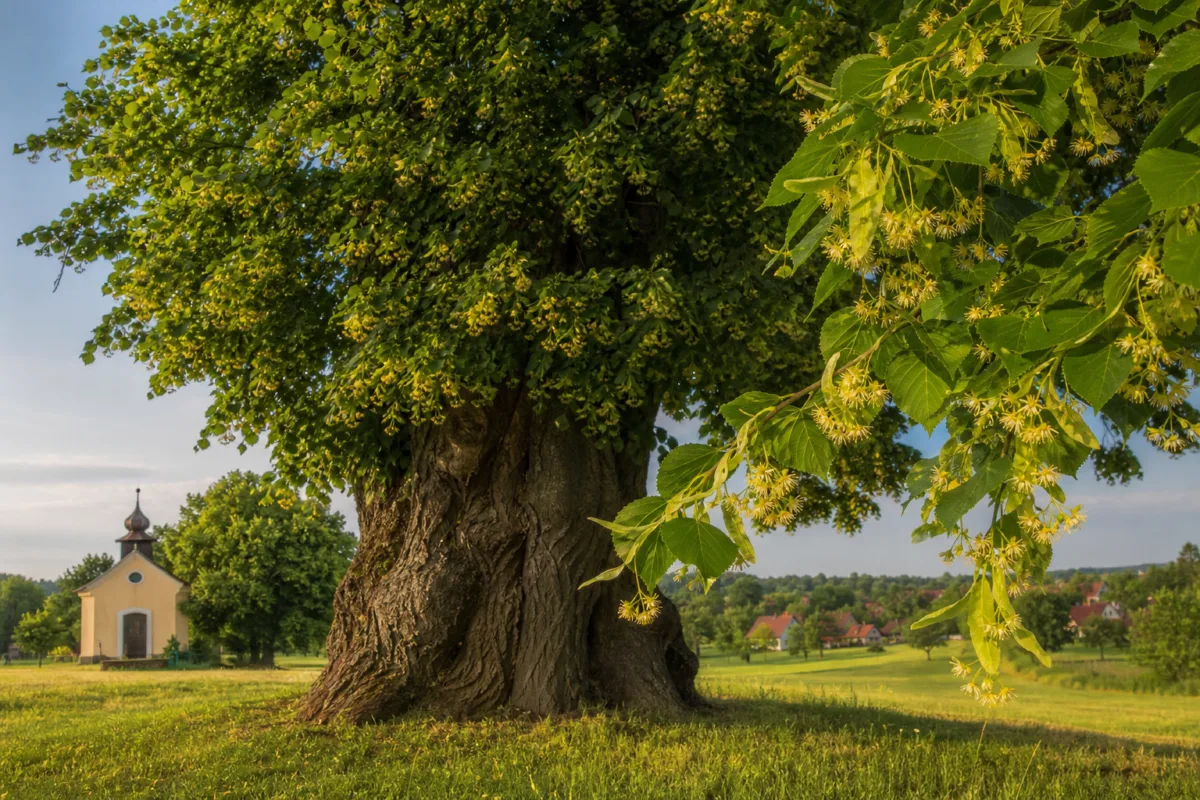
A lime typically has a tall, domed, dense and regular crown, which in free-standing trees resembles an egg or a broad cupola. Old specimens have massive trunks, often hollow and surrounded by suckers at the base. The bark is grey to grey-brown, smooth at first, later shallowly fissured lengthwise into a fine network.
The most reliable feature is the leaf: heart-shaped, asymmetrical at the base, with a short pointed tip and serrated margin, on a long stalk. Winter buds are ovoid, glossy, greenish-red to dark red and covered by only two or three visible scales, which distinguishes lime in winter from, for example, beech with its long, spindle-shaped buds.
The flowers are small, yellowish-white, bisexual and intensely fragrant. They grow in cymes whose stalk is fused for about half its length to a tongue-shaped, pale green bract. Once ripe, this acts as a wing, helping the wind carry the fruits – nutlets – tens of metres from the tree.
Limes growing in the Czech Republic
Small-leaved lime (Tilia cordata)
The most widespread lime in Czech woods and avenues. Its leaves are smaller, about 3–8 cm, bluish-green and hairless beneath except for rusty-brown tufts of hair in the vein axils. Each cyme bears 5–11 flowers that stick out obliquely upwards or sideways from the crown. The nutlet is small, thin-shelled, without prominent ribs and easily crushed between the fingers. It flowers from late June to mid-July. Its range extends from the Pyrenees and Britain across all of Europe to beyond the Urals.
Large-leaved lime (Tilia platyphyllos)
It has larger leaves, usually 6–12 cm, green and softly hairy beneath, with whitish tufts of hair in the vein axils. Young shoots are often downy. Each cyme carries only 2–5 larger, drooping flowers. The nutlet is woody and hard, with 4–5 prominent lengthwise ribs, and cannot be crushed with the fingers. It flowers from about mid-June, the first of the native limes. It needs more nutrients and moisture and typically grows on slopes, in ravines and on limestone soils in central and southern Europe.
Common lime (Tilia × europaea)
A hybrid of the two native species that also arises spontaneously in the wild. Its features are intermediate – medium-sized leaves, almost hairless beneath with whitish to brownish tufts, and faintly ribbed nutlets. Thanks to its vigorous growth it was widely planted in avenues and parks, often as the cultivar 'Pallida'. Numerous suckers on the trunk are typical.
Non-native limes in parks and gardens
- Silver lime (Tilia tomentosa) – from south-eastern Europe, leaves densely white-felted beneath, flowers latest of all (July to August). Tolerates drought and urban conditions well. Dead bumblebees are sometimes found beneath flowering trees; current research suggests the cause is a lack of nectar in late summer and insect exhaustion rather than toxic nectar.
- Caucasian lime (Tilia × euchlora) – with glossy dark green leaves, popular as a street tree because it is less prone to aphids.
- American basswood (Tilia americana) – with especially large leaves up to 20 cm, known in North America as basswood.
- Weeping silver lime (Tilia tomentosa 'Petiolaris') – a pendulous cultivar of silver lime with long leaf stalks.
| Feature | Small-leaved lime | Large-leaved lime |
|---|---|---|
| Leaf size | 3–8 cm | 6–12 cm |
| Leaf underside | bluish, hairless, rusty tufts | green, hairy, whitish tufts |
| Flowers per cyme | 5–11 | 2–5 |
| Nutlet | thin-shelled, unribbed | hard, with 4–5 ribs |
| Start of flowering | late June | mid-June |
Where limes grow and their ecology
In natural Czech forests limes are not dominant, but they are an important admixture. Small-leaved lime grows in oak-hornbeam woods, floodplain forest margins and thermophilous oak woods, from lowlands up to about 800–1,000 m above sea level. Large-leaved lime is typical of scree and ravine forests, where it grows alongside sycamore maple, wych elm and ash; it is common, for example, in the Bohemian Karst, the České středohoří hills and the river canyons of Moravia.
Limes are fairly shade-tolerant, especially when young, and have a deep heart-shaped root system, so they stabilise slopes well. Their leaf litter decomposes quickly and enriches the soil, earning them the label of soil-improving trees. They coppice vigorously, which is why they were traditionally grown in coppice woods.
For insects, lime is one of the most important summer forage plants: in favourable weather it yields large amounts of nectar, and lime honey is a prized varietal honey. Many invertebrates live on the leaves, from aphids and moth caterpillars to gall mites. The firebug, a harmless bug feeding on fallen seeds, often basks in groups at the base of lime trunks.
Wood and uses
Lime wood is pale, yellowish-white, soft and light (density about 500–550 kg/m³), with a fine, even texture. It is easy to work and rarely cracks, so it has long been the main material of woodcarvers: Gothic Madonnas and altarpieces, nativity scenes, puppets and folk toys were all carved from lime. It is also used for musical instruments (electric guitar bodies, organ parts), artist's charcoal, pencils, veneers, plywood, drawing boards and furniture parts not subject to mechanical stress. Outdoors it rots quickly without protection, so it is unsuitable for construction.
Bast – the tough fibrous inner bark – was once of great importance, woven into ropes, mats, baskets and even shoes (bast shoes). Lime flowers (Tiliae flos) are picked at the start of flowering together with the bract and dried in the shade. The tea is diaphoretic and calming, traditionally drunk for colds, fever and coughs. Collect only from native species and from trees away from busy roads.
Growing lime in the garden
Planting and site
Lime is a tree for large gardens, parks, village greens and avenues. Bear in mind that the mature crown reaches 15–20 m across, so plant it at least 10 m from the house. Plant in autumn after leaf fall or in early spring, ideally bare-root or root-balled trees. A sunny to partly shaded spot is best; small-leaved lime tolerates shade too.
Soil and care
- Soil: deep, fertile, moist, neutral to slightly alkaline. Large-leaved lime is more demanding, small-leaved more tolerant.
- Watering: regular for the first 3–5 years after planting; established trees are fairly resilient, though prolonged droughts in recent years have caused early browning and leaf drop.
- Pruning: lime takes shaping well and can be grown as a clipped hedge, pleached screen or trained lime with a candelabra crown. Do formative pruning while young and remove basal suckers regularly.
- Cultivars for smaller spaces: small-leaved lime 'Greenspire' or 'Rancho' with narrower crowns, or Caucasian lime.
Pests and diseases
The most common problem is aphids, whose sticky honeydew drips onto cars and benches and becomes covered in black sooty mould. In hot weather the lime spider mite attacks the leaves, causing bronzing and early leaf fall. The conspicuous red horn-like galls of the lime nail gall mite are harmless to the tree. Diseases include leaf spot and, in weakened trees, trunk rots caused by wood-decay fungi. Old hollow limes are often surprisingly stable but need regular inspection by an arborist.
Curiosities and cultural significance
The lime was a sacred tree of the Slavs, dedicated to the goddess of love and fertility. It grew by springs, on village greens and beside churches, and courts, assemblies and festivities were held beneath its crown. It was symbolically declared the national tree by the Slavic Congress in Prague in 1848. After Czechoslovakia was founded in 1918, liberty limes were planted across the country, a tradition repeated after 1945, 1968 and 1989.
Lime sprigs adorn the standard of the President of the Republic, and lime leaves have appeared on state decorations, coins and banknotes. Many place names derive from the lime – Lipník, Lipno, Lipová, Česká Lípa and Leipzig (from the Sorbian Lipsk). The Czech Republic has hundreds of memorial limes, some with trunk girths over 10 m and estimated ages of 600–800 years; they are among the oldest living trees in the country.
Other native broadleaf trees and how they compare with lime can be found in our overview of broadleaf trees.
Summary
The lime is a long-lived broadleaf tree of the mallow family, represented in the Czech Republic by the small-leaved lime, the large-leaved lime and their hybrid, the common lime. They can be told apart by leaf size and underside, the colour of the hair tufts in the vein axils, the number of flowers and the hardness of the nutlets. Valued by bees, woodcarvers and folk medicine alike, the national tree is an integral part of the Czech landscape, village greens and avenues.
FAQ
How do I tell small-leaved lime from large-leaved lime?
Small-leaved lime has smaller leaves with a bluish, hairless underside and rusty tufts of hair in the vein axils; large-leaved lime has larger leaves with a hairy underside and whitish tufts. The nutlets are also reliable: those of small-leaved lime crush easily, while large-leaved lime nutlets are hard and ribbed.
When does lime flower and when should lime blossom be picked?
Large-leaved lime flowers from mid-June, small-leaved lime from late June to mid-July. Pick the flowers with their bracts at the start of flowering in dry weather and dry them in the shade.
Why is the lime the national tree of the Czech Republic?
The lime was a sacred tree of the Slavs and a symbol of community. It was symbolically declared the national tree by the Slavic Congress in Prague in 1848, and lime sprigs also feature on the presidential standard.
How long do lime trees live?
Limes commonly live 300 to 500 years, and exceptional memorial trees in the Czech Republic are estimated at 600 to 800 years old, making them among the longest-lived broadleaf trees in the country.
Which family does the lime belong to?
Under the current APG IV system, lime belongs to the mallow family (Malvaceae), subfamily Tilioideae. Older literature places it in a separate family, Tiliaceae.
Why does a sticky liquid drip from lime trees?
It is honeydew, a sugary secretion of aphids feeding on the leaves. It does little harm to the tree but soils everything beneath the crown and becomes covered in black sooty mould.