Hornbeam (Carpinus): the tough tree of Czech woodlands and hedges
Scientific name: Carpinus
Hornbeam (Carpinus) is a hardy broadleaf genus in the birch family, typical of oak–hornbeam woods in the lowlands and uplands of the Czech Republic. With very hard wood and excellent tolerance of pruning, it ranks among the best trees for clipped hedges.
 Tomáš Rohlena
8 min read
This article was translated from Czech. Čeština
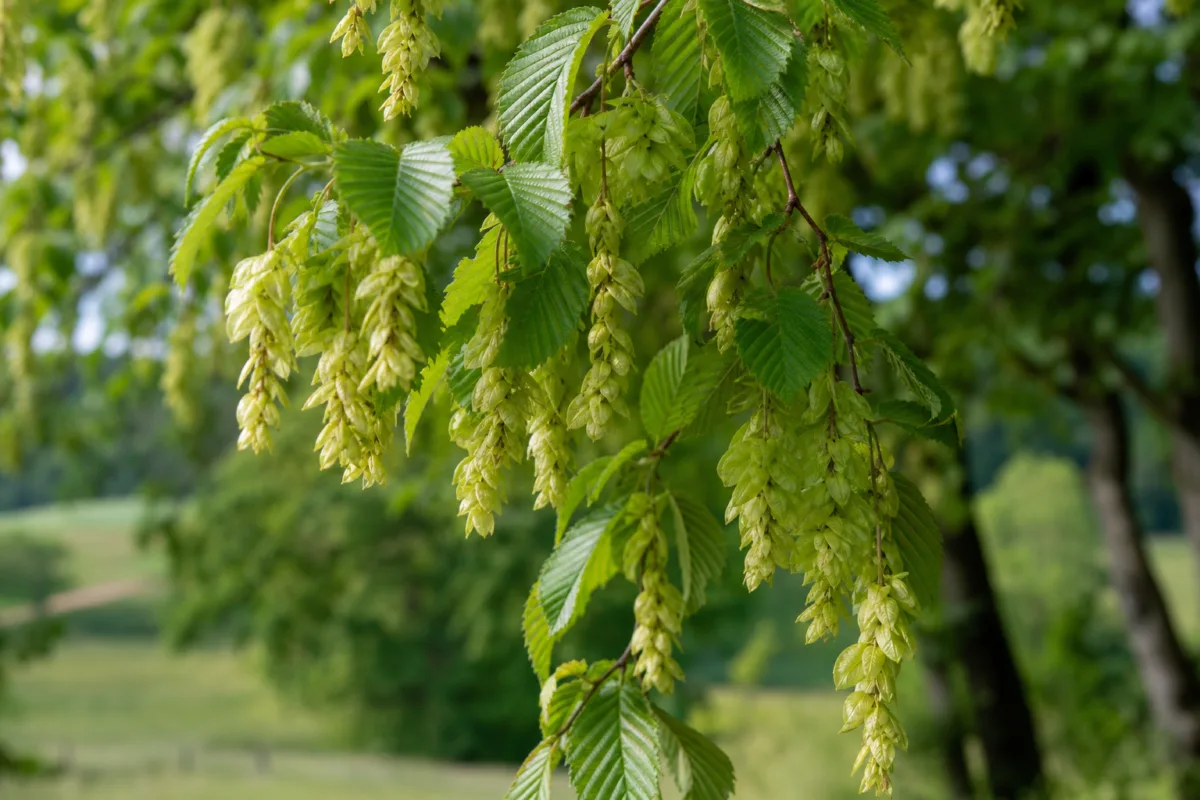
Hornbeam (Carpinus) is a tough broadleaf genus, most often represented in Czechia by the European hornbeam—a key species of oak–hornbeam woods and, at the same time, one of the most reliable trees for hedges. You can recognise it by its oval, strongly veined leaves with double serration and by its fruits with conspicuous “wings” (bracts).
In the landscape, hornbeam is highly important: it forms a shady layer in mixed forests, stabilises soils, and provides shelter and food for many animals. In gardens it works as a clipped hedge, a specimen tree, and an avenue tree—especially in narrow-crowned cultivars.
Quick facts (hornbeam in Czechia)
| Scientific name (genus) | Carpinus |
|---|---|
| Family | birch family (Betulaceae) |
| Height | most often 15–25 m, exceptionally up to about 30 m (in C. betulus) |
| Lifespan | usually 150–250 years, occasionally 300+ years |
| Leaves | simple, alternate, oval, strongly veined, double-serrated |
| Flowering | April–May (male and female catkins on the same tree) |
| Fruit | small nuts (achenes) in a three-lobed bract, ripening in autumn |
| Habitat in Czechia | lowlands and uplands; oak–hornbeam woods, woodland edges, slopes; also commonly planted in towns |
| Protection | the genus as a whole is not specially protected; it is important in natural forest communities |
How to identify hornbeam with confidence
Leaves: “pleated” veins and double serration
Hornbeam leaves are 5–10(12) cm long, oval to elliptic, dull green above and paler beneath. A typical feature is the many parallel lateral veins running all the way to the leaf edge—making the leaf look slightly “pleated” or corrugated. The margin is double-serrated (larger teeth carry smaller toothlets).
Bark and habit: smooth grey with “muscular” fluting
The bark is smooth and grey for a long time; later it may become shallowly furrowed. Older trunks often show characteristic longitudinal raised “ribs” (sometimes described as muscular). The crown is dense and resprouts well even after hard pruning.
Flowers and fruit: catkins and striking bracts
Hornbeam is monoecious. Male catkins are longer and pendulous, while female catkins are shorter at first and later elongate into fruiting clusters. The fruits are small nuts, each with a three-lobed bract that helps wind dispersal. These bracts are often the easiest way to spot hornbeam in late summer and autumn.
Look-alikes: hornbeam vs beech
Hornbeam is most often confused with beech. Beech has leaves with a more entire margin (only slightly wavy) and a noticeably glossier surface, plus long, pointed buds. Hornbeam has double-serrated leaves and, in autumn, fruiting clusters with bracts, while beech produces beechnuts in a spiny cupule. More on beech can be found in the article Beech: identification, species, occurrence in Czechia, wood and cultivation.
Hornbeam species in the Czech Republic (native and planted)
In Czech nature, essentially only one species is native; others occur mainly in parks, arboreta, and private gardens.
- European hornbeam (Carpinus betulus) – native in Czechia, the most common in the landscape and in plantings; excellent for hedges.
- Oriental hornbeam (Carpinus orientalis) – a more warmth-loving species of south-eastern Europe; in Czechia it is rather rarely planted, on warmer sites and sometimes in dendrological collections.
- American hornbeam (Carpinus caroliniana) – grown as an ornamental, valued for attractive autumn colour; prefers moister soils.
- Japanese hornbeam (Carpinus japonica) and related Asian species (e.g. C. cordata) – mostly collector’s trees, used in parks and larger gardens.
In everyday practice, forestry, and urban greenery, however, C. betulus is the decisive species.
Where hornbeam grows and its ecology
European hornbeam is a typical tree of the lowlands and uplands, roughly from 200 to 700 m a.s.l., locally higher in warmer areas. It occurs mainly in oak–hornbeam woods (alliance Carpinion betuli) and in diverse mixed forests, where it complements oaks, limes (lindens), maples and ashes.
- Light: tolerates partial shade to shade; when young it is more shade-tolerant. In deep shade it grows slowly but survives.
- Soils: best on loamy, fertile, slightly moist soils; it can cope with drier sites unless conditions are extreme.
- Water: dislikes prolonged waterlogging, but copes with short dry spells better than many trees.
- Resilience: withstands wind well thanks to a dense crown and flexible branches; in towns it tolerates pruning and pollution fairly well.
Ecologically, it matters as a soil-stabilising, soil-protecting tree—its leaf litter decomposes relatively quickly and enriches the soil with nutrients. Dense branching provides cover for birds and small mammals; seeds are used by some birds and rodents.
If you are interested in other native broadleaf trees and their roles in the landscape, see the overview Broadleaf trees.
Hornbeam wood: extremely hard, but tricky to dry
Hornbeam wood is among the hardest and densest of common European timbers. It is pale and fine-grained, highly resistant to mechanical wear, but it is harder to impregnate and may crack if dried too fast or carelessly.
- Traditional uses: tool handles, wedges, mallets, machine parts, mill components, and historically even gear wheels.
- Firewood: excellent—high calorific value and long-lasting embers; highly prized for heating.
- Forestry: often a mixed-in species that increases stand stability and biodiversity, but it can also regenerate vigorously and compete with more light-demanding trees.
Growing hornbeam in the garden (planting, pruning, care)
Why hornbeam is number one for hedges
Hornbeam is exceptionally well suited to hedges because it tolerates repeated pruning extremely well, thickens from the base, and forms a compact screen. It also often holds on to some dead leaves through winter (especially in clipped hedges), so it provides privacy beyond the growing season.
When to plant and what to buy
- Bare-root plants: the most common and cost-effective option; plant in autumn after leaf fall or in early spring.
- Container-grown plants: can be planted almost year-round (except during frost or extreme heat), but require careful watering after planting.
For a hedge, typical spacing is about 3–5 plants per metre (depending on plant size and how fast you want it to knit together). For avenues and specimen trees, give hornbeam enough room—it will eventually form a broad, dense crown.
Site: soil, light, watering
- Light: sun to partial shade; tolerates shade too (slower growth).
- Soil: ideally loamy, fertile, slightly moist; pH from slightly acidic to neutral.
- Watering: water regularly for 1–2 seasons after planting; later, rainfall is usually enough, though mulch helps hedges in dry spots.
Pruning: when and how to encourage density
Basic shaping cuts for hedges are done 1–2 times per year:
- spring (March–April): the main cut before budbreak or at the start of leafing-out, depending on weather and your goal (rejuvenation vs shaping),
- summer (July–August): a maintenance trim for a crisp outline.
For a dense hedge, it is important to shape it into a slight trapezoid (wider at the bottom, narrower at the top) so the lower parts are not shaded out.
Varieties and forms (cultivars)
- Carpinus betulus ‘Fastigiata’/‘Frans Fontaine’: a narrow, columnar habit suitable for streets and smaller gardens.
- ‘Pendula’: a weeping form, a decorative specimen tree.
- ‘Columnaris’: compact, upright growth.
Diseases and pests
Hornbeam is usually healthy, but issues can appear especially under stress (drought, compacted soil, repeated overheating of soil along a hedge):
- powdery mildew (whitish coating on leaves) – usually cosmetic; an airier site and avoiding excess nitrogen helps,
- aphids and other sap-suckers – if heavy, rinse with water, support predators, or use a targeted treatment,
- leaf spots – collect infected leaves in autumn; improve overall plant vigour,
- dieback after planting – the most common issue: insufficient watering in the first 1–2 years.
Hornbeam in the Czech landscape and culture: “ordinary”, but essential
European hornbeam may seem unremarkable, but it is extremely important in the landscape. In oak–hornbeam woods it forms, together with oaks and limes (lindens), the structural backbone of the stand; along forest edges and in small copses it acts as a windbreak and shelter. Thanks to its ability to regenerate and resprout from stumps, it was also historically used in coppice woodland and mixed management systems.
In urban settings it is valuable because it tolerates pruning well and can be trained into precise shapes. In avenues it often competes with lime or maple—both genera have their own overviews on our website (Lime/Linden (Tilia), Maple (Acer)), making it easy to compare requirements and growth.
Brief summary
- Hornbeam (Carpinus) is a genus in the Betulaceae family; in Czechia the key species is European hornbeam (C. betulus).
- It is recognised by double-serrated, strongly veined leaves and fruits with three-lobed bracts.
- It grows mainly in oak–hornbeam woods of lowlands and uplands, and tolerates partial shade and pruning well.
- It has very hard wood and is among the best trees for hedges.
For broader context among our native trees, also visit Broadleaf trees and the comparison article on beech: Beech.
FAQ
Are hornbeam and beech the same tree?
No. Hornbeam (Carpinus) and beech (Fagus) are different genera; hornbeam has double-serrated leaves and fruits with bracts, while beech has beechnuts in a spiny cupule.
How fast does hornbeam grow in a hedge?
Growth depends on soil and moisture; typically it puts on several tens of centimetres per year. With good care, a hedge usually fills in within a few years.
When should you trim hornbeam to make it denser?
Most often in spring (the main cut) and optionally in summer (a maintenance trim). It is important to shape the hedge wider at the bottom than at the top.
Does hornbeam drop all its leaves in winter?
As a deciduous tree it does, but clipped hedges often retain some dry leaves on the branches until spring, which increases privacy.
Can hornbeam handle drought and urban conditions?
It is fairly resilient and does well in towns, but it needs watering after planting; in severe drought, mulch and occasional deep watering help.
FAQ
Are hornbeam and beech the same tree?
No. Hornbeam (<em>Carpinus</em>) and beech (<em>Fagus</em>) are different genera; hornbeam has double-serrated leaves and fruits with bracts, while beech has beechnuts in a spiny cupule.
How fast does hornbeam grow in a hedge?
Growth depends on soil and moisture; typically it puts on several tens of centimetres per year. With good care, a hedge usually fills in within a few years.
When should you trim hornbeam to make it denser?
Most often in spring (the main cut) and optionally in summer (a maintenance trim). It is important to shape the hedge wider at the bottom than at the top.
Does hornbeam drop all its leaves in winter?
As a deciduous tree it does, but clipped hedges often retain some dry leaves on the branches until spring, which increases privacy.
Can hornbeam handle drought and urban conditions?
It is fairly resilient and does well in towns, but it needs watering after planting; in severe drought, mulch and occasional deep watering help.