Hazel (Corylus): identification, species in the Czech Republic, ecology and growing
Scientific name: Corylus
Hazel (genus Corylus) is a common shrub (sometimes also a tree) in the Czech landscape, important for biodiversity and as a source of hazelnuts. It’s easy to recognise by its winter catkins and rounded, serrated leaves; in the Czech Republic the main native species is common hazel, while other species are planted in parks and gardens.
 Tomáš Rohlena
7 min read
This article was translated from Czech. Čeština
Hazel (Corylus) is a genus of deciduous woody plants in the birch family (Betulaceae). In the Czech landscape you’ll most often encounter it as a dense shrub along woodland edges, in scrub and hedgerows. It matters both ecologically (early pollen for insects, nuts for birds and mammals) and practically—as a traditional fruiting and utility plant.
In Czechia, the main native species is common hazel (Corylus avellana). In parks and plantings you may also see the tree-form Turkish hazel (Corylus colurna), as well as cultivated varieties derived from Corylus maxima and hybrids.
Quick overview
| Scientific name | Corylus (genus) |
|---|---|
| Family | Betulaceae (birch family) |
| Height | most often 2–6 m (shrub); tree-form 15–25(30) m in C. colurna |
| Lifespan | typically 60–100 years; tree hazels can reach 200+ years (depending on species and site) |
| Leaves | alternate, rounded to ovate, coarsely serrated, often with a heart-shaped base |
| Flowering | II–IV; male flowers in catkins, female flowers inconspicuous (red stigmas) |
| Fruit | nuts in a leafy involucre (husk), ripening VIII–IX |
| Habitat in Czechia | woodland edges, scrub, hedgerows, small copses; from lowlands to hills and foothills |
| Protection | the genus is not protected nationwide; locally an important habitat and hedgerow component |
How to identify hazel reliably
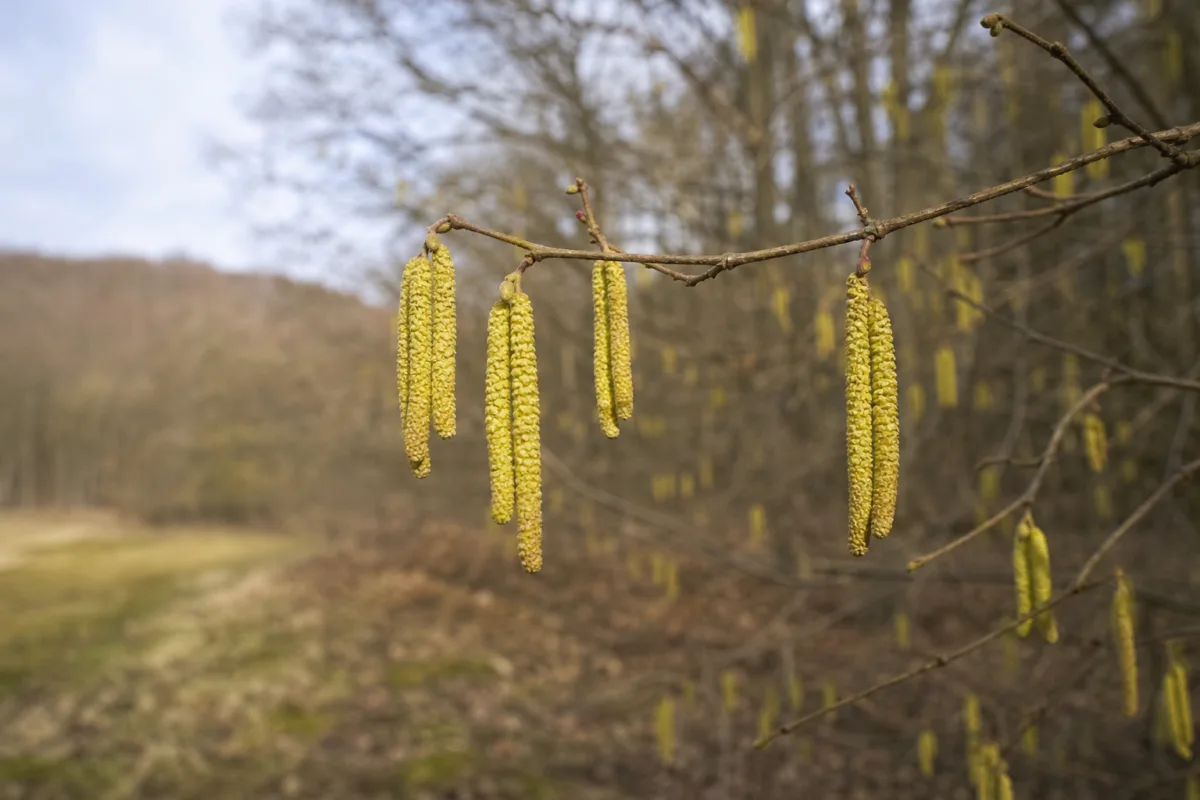
Hazel is typically a multi-stemmed shrub with many shoots arising from the base. In winter and very early spring it gives itself away by its long male catkins, which often hang on the twigs from autumn onwards and release pollen with the first warm spell.
- Catkins (male inflorescences): 5–10 cm long, yellowish, conspicuous in winter and in February/March.
- Female flowers: inconspicuous buds with tiny red stigmas protruding (often visible only when you look closely).
- Leaves: rounded to broadly ovate, coarsely serrated, often slightly rough to the touch; short petiole. They turn yellow in autumn.
- Bark and shoots: young shoots are often hairy; older bark grey-brown and fairly smooth.
- Fruit: nuts in clusters of 1–5; the husk can be short and fringed (C. avellana) or noticeably elongated (C. maxima).
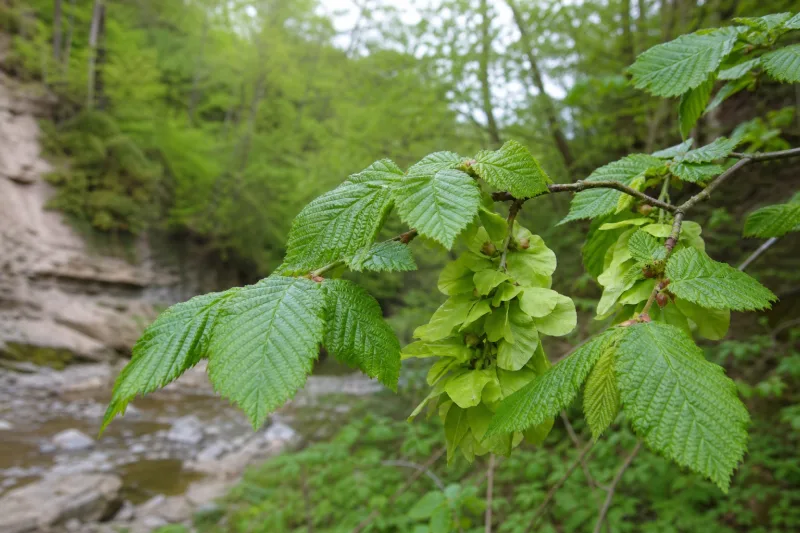
Confusion is most likely with hornbeam (Carpinus) or young birches (Betula), but hazel typically has rounder leaves, and during flowering it can be identified confidently by the catkins and female flowers. For broader context on broadleaf trees, see also Broadleaf trees.
Hazel species in the Czech Republic (native and planted)
In Czech conditions you’ll most often encounter the native species, plus a few planted species and ornamental cultivars. Worldwide, the genus Corylus includes roughly 15–20 species (depending on taxonomy), but only some are common here.
Common hazel (Corylus avellana)
Native and very widespread. It grows as a shrub (usually 2–6 m, taller in favourable conditions) and often forms part of woodland margins and scrub. It’s important for wildlife: the nuts feed jays, woodpeckers, small rodents and squirrels.
Turkish hazel (Corylus colurna)
In Czechia it is often planted in parks, streets and larger gardens. Unlike common hazel, it is a tree (commonly 15–25 m) with a more regular crown and less tendency to form shrubby thickets. It bears nuts in numerous clusters with a distinctly “shaggy” husk. Under good conditions it is long-lived and tolerates urban environments well.
Filbert (Corylus maxima) and cultivated varieties
Corylus maxima is the source of many cultivated varieties (filberts). Gardens also grow hybrids between C. avellana and C. maxima—in practice these are often simply “hazels for nuts” without the need for exact species identification. A typical feature in some cultivars is a more elongated husk that covers the nut more fully.
Ornamental cultivars (e.g. purple-leaved and contorted forms)
Especially popular in parks and gardens are:
- purple-leaved hazels (cultivars most often derived from C. avellana),
- contorted hazels (cultivars such as ‘Contorta’), valued for their winter branch silhouette.
With ornamental forms, nuts may be smaller and yields can vary; the goal is often appearance rather than harvest.
Where hazel grows and its role in the ecosystem
Common hazel is a typical plant of woodland edges, glades, clearings, scrub and hedgerows. It regenerates well from stumps and readily thickens stands—so you’ll often find it in places with past logging, or as part of living fences and hedges.
- Site: it prefers fresh, nutrient-rich soils, often on more calcareous substrates, but it is fairly adaptable.
- Light: it tolerates partial shade, but for abundant flowering and nut production it benefits from more light (edges and margins).
- Elevation: common from lowlands through hilly country to foothills; in cooler areas it may fruit less.
Ecologically, hazel is valuable because it provides early pollen (often as early as February). It’s also worth noting that it is one of the key woody plants associated with early-season pollen allergies. The nuts are an energy-rich food source and contribute significantly to many animals’ “autumn menu”.
In diverse broadleaf stands, hazel often mixes with trees featured in our other guides, such as beech, maple or birch.
Wood and traditional uses
Hazel wood is hard, flexible and tough, but stems are usually thinner, so historically it was used mainly as rods and poles. Hazel coppices very well after cutting, making it suitable for coppice management.
- Rods and poles: fences, hurdles, basketry, simple structures, and plant supports.
- Tools and small items: handles, shafts and walking sticks (valued for flexibility).
- Nuts: a food rich in fats and protein, prized in baking and confectionery. In gardens, though, expect “competition” from birds and rodents.
In the landscape, hazel also helps as a slope-stabilising shrub in small copses and field margins, providing cover for small birds.
Growing hazel in the garden (nuts and ornament)
Hazel is generally easy to grow in gardens. The biggest difference between an “ornamental” and a “productive” hazel is not difficulty, but how you approach pruning, space, and pollination.
Where to plant it (light, soil, space)
- Light: ideally full sun to light partial shade. It will grow in shade, but flowers and fruits less.
- Soil: fresh, deeper, humus-rich; it dislikes long-term waterlogging. In extremely dry sites it suffers and nuts are small.
- Space: shrub forms need several metres of width; tree-form C. colurna is better suited to larger gardens and avenues.
Planting
Container-grown or bare-root plants establish best when planted in autumn (or very early spring). After planting, watering and mulching are important to prevent drying out and suppress weeds.
Pollination and nut yield
Hazel is wind-pollinated, and many cultivars crop better when a genetically different cultivar is present (due to pollen compatibility and overlapping flowering times). In practice: if you want a reliable harvest, consider planting at least two different cultivars within a few dozen metres.
Pruning and training
- Shrub form (most common): regularly remove the oldest and overcrowding shoots at ground level to open up the shrub. The aim is several strong stems of different ages.
- Single-stem tree: you can train one main trunk (with suitable material), but it requires regular removal of basal suckers.
- Rejuvenation: hazel tolerates hard cutting (coppicing) and resprouts well; however, fruiting usually drops temporarily.
Pruning is typically done outside periods of severe frost, often in late winter to early spring. In early spring, though, pay attention to the catkins—heavy pruning can reduce the number of flower clusters for that year.
Most common pests and diseases
- Hazelnut weevil (Curculio nucum): larvae eat the kernels and nuts fall prematurely. Collect and dispose of infested nuts promptly and keep the ground under shrubs clean.
- Big bud mite (Phytoptus avellanae): causes conspicuously swollen buds and reduces leafing and fruiting. Remove and destroy affected buds or shoots.
- Browsing and crop losses: squirrels, mice and jays can “harvest” before the gardener does; timely picking and reasonable protection help.
- Fungal leaf spots: usually not fatal; maintain an airy crown and avoid over-fertilising with nitrogen.
Interesting facts and cultural significance
- Catkins as a winter ID feature: hazel is one of the most rewarding woody plants for winter botany—catkins stand out when most broadleaf trees are “silent”.
- Rods and tradition: hazel rods were widely used in folk culture; their flexibility and straightness are still valued today.
- Food and dispersal: nuts are often carried and cached by animals, which can help hazel spread across the landscape.
- Urban planting: tree-form Corylus colurna is favoured in some towns for its resilience and attractive crown, and it is not as aggressively suckering as C. avellana.
In brief
Hazel (Corylus) in the Czech Republic is represented above all by the native common hazel—a shrub of woodland margins, hedgerows and scrub, easily recognised by winter catkins and rounded leaves. It’s a rewarding garden plant: with enough light, space and appropriate pruning it can produce a steady nut crop, while ornamental cultivars add striking structure even in winter. Ecologically, it is valuable for wildlife and as part of the diverse mosaic of broadleaf woody plants in the landscape.
For further reading, compare hazel with other common broadleaf trees in our articles: Broadleaf trees, beech, maple, rowan.
FAQ
When does hazel flower in Czechia?
Most often from February to April, depending on weather and location. Male catkins can be visible already in winter and release pollen on the first warmer days.
Is hazel a tree or a shrub?
The most common species, common hazel (Corylus avellana), is usually a multi-stemmed shrub in Czechia. The main tree-form species is Turkish hazel (Corylus colurna), often planted in parks.
Why does my hazel produce few nuts?
Common causes are too much shade, summer drought, an over-dense shrub, or a lack of a suitable pollinator (a different cultivar flowering at the same time). Wildlife and the hazelnut weevil can also reduce yields significantly.
How can I tell hazel from hornbeam?
Hazel usually has rounder, coarsely serrated leaves and conspicuous catkins in early spring; the female flowers show tiny red stigmas. Hornbeam leaves are more elongated with more pronounced veins and it has a different type of fruit.
When are hazelnuts harvested?
Usually from late August into September, once the nuts are ripe and start to drop out of their husks. In practice it pays to pick regularly, as squirrels and rodents find the crop quickly.
Does hazel tolerate hard pruning or rejuvenation?
Yes. Hazel resprouts very well from the stump and tolerates rejuvenation. After hard cutting, however, fruiting usually drops temporarily until new shoots form flower clusters again.