Douglas-fir (Pseudotsuga): a fast-growing conifer for Czech forests and gardens
Scientific name: Pseudotsuga
Douglas-fir (genus Pseudotsuga) is a North American conifer widely grown in the Czech Republic in forests and parks thanks to its fast growth and high-quality timber. The most reliable way to identify it is by its cones with conspicuous three-pointed bracts and by its flat, aromatic needles.
 Tomáš Rohlena
7 min read
This article was translated from Czech. Čeština
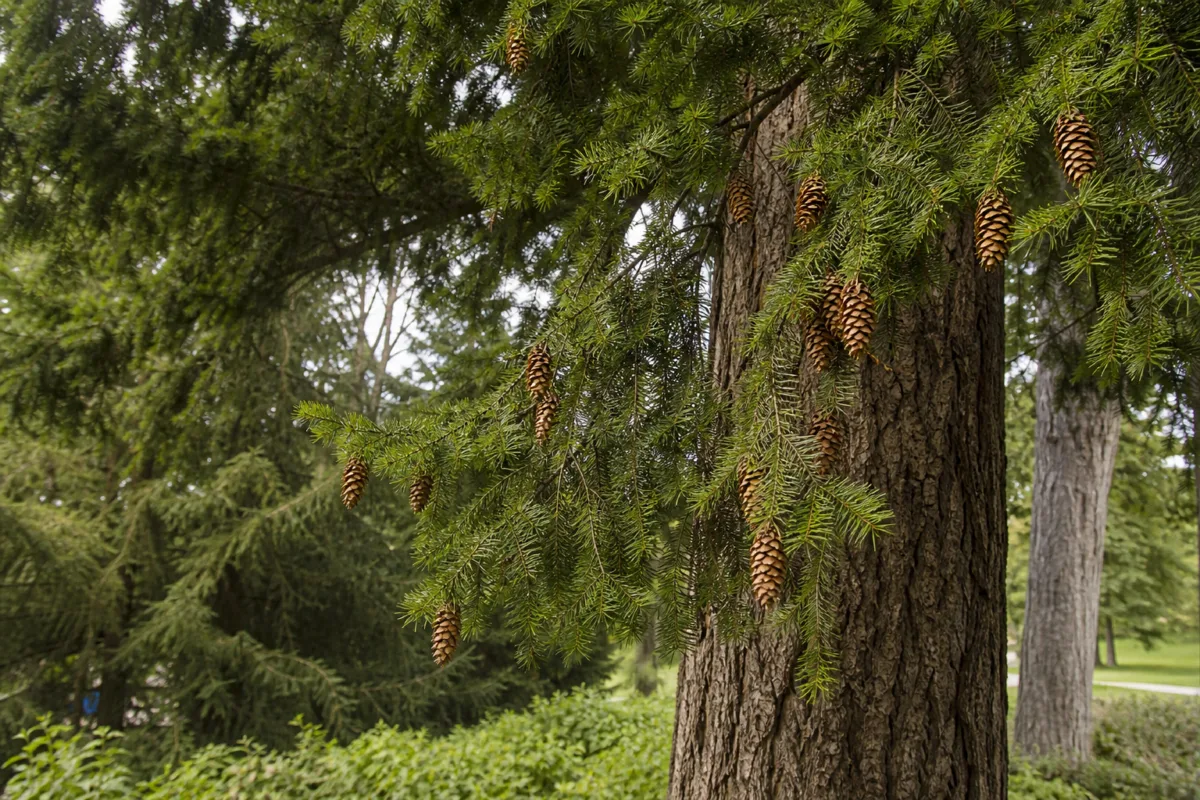
Douglas-fir (Pseudotsuga) is a non-native conifer in the Czech Republic, but one that is commonly planted. It belongs to the pine family (Pinaceae) and is valued for its fast growth, more stable timber production across many site types, and good resistance to wind. In the field it is characterised by cones with protruding three-pointed bracts and flat needles that, when crushed, often smell pleasantly resinous—sometimes even with a citrus note.
Unlike our native conifers, it does not form natural stands in the Czech Republic, though in places it can regenerate locally from seed. In forestry, the most important species is Douglas-fir (Pseudotsuga menziesii), for which different provenances (origins) are used with differing traits.
Quick overview (genus Pseudotsuga in the Czech Republic)
| Scientific name | Pseudotsuga Carrière (most commonly Pseudotsuga menziesii) |
|---|---|
| Family | Pinaceae (pine family) |
| Height | In the Czech Republic commonly 30–50 m, exceptionally around 60 m; in the native range up to 80+ m (record trees even higher) |
| Lifespan | In the Czech Republic often 150–300 years; in the native range several centuries (exceptionally 500+ years) |
| Needles | Flat, soft, 2–3.5 cm, arranged spirally but visually in “two rows”; aromatic when crushed |
| Flowering | Spring (usually April–May depending on location) |
| Fruits | Cones 5–10 cm (in the commonly planted Douglas-fir), with distinctive three-pointed bracts protruding between the scales |
| Habitat in the Czech Republic | Forest plantations, mixed stands, avenues and parks; best on deeper, fresh to slightly moist soils in uplands and highlands |
| Protection status | No special protection; a non-native taxon grown in forestry and ornamental planting |
How to identify Douglas-fir with confidence
At first glance, Douglas-fir can be confused with spruce or fir. The decisive features are details on the needles and cones.
- Cones: hang down, are elongated, and have three-pointed bracts protruding between the seed scales (often likened to a “mouse tail with two little legs”). This is the most reliable field mark.
- Needles: flat, relatively soft, attached singly on the twig. When crushed, they often smell aromatic (resinous, sometimes citrus-like). Unlike spruce, they usually do not prick.
- Buds: conspicuously narrow and pointed, often rusty brown. Fir buds tend to be blunter and often resinous.
- Bark: on young trees smoother with resin blisters; with age thick, deeply furrowed and corky (good protection against smaller fires in its homeland; in the Czech Republic it is mainly an identification feature of older trees).
For comparison, it helps to know the differences from the most common “look-alikes”: in spruce (Picea) the cones lack protruding bracts and the needles are typically four-angled and sharp; in fir (Abies) the cones stand upright on the branches and disintegrate on the tree.
Douglas-fir species and provenances grown in the Czech Republic
The genus Pseudotsuga includes several North American species and one East Asian species, but in practice in the Czech Republic you will almost always encounter a single taxon:
- Douglas-fir (Pseudotsuga menziesii) – the key forestry and park species in the Czech Republic. Within the species, provenances from the coastal and interior parts of the range are distinguished; they differ in growth rate, frost hardiness and response to drought.
More rarely, other species (e.g. Pseudotsuga macrocarpa) may appear in arboreta or collections, but they are not important for the general landscape and forests of the Czech Republic. For successful planting, it is crucial to choose reproductive material of suitable origin for the given elevation and climate conditions.
Where Douglas-fir grows in the Czech Republic and its ecology
Douglas-fir is a non-native tree in the Czech landscape, planted mainly since the late 19th century. It is introduced into conifer and mixed stands both as an admixture and, on selected sites, as a main species.
Site requirements can be summarised as follows:
- Soil: best on deeper, more fertile, well-aerated, fresh to slightly moist soils; it tolerates slightly acidic to neutral conditions. Permanently waterlogged soils are unsuitable.
- Water and drought: compared with spruce, it often copes better with episodes of drought, but on shallow, overheating soils (stony ground, extremely dry slopes) it may suffer, especially when young.
- Light: generally a semi-shade to light-demanding species; young trees tolerate partial shade, but long-term deep shade slows growth.
- Frost and late frosts: young shoots can be damaged by late frosts; an appropriate provenance and a site outside frost hollows is essential.
In terms of biodiversity, it is important to note that Douglas-fir does not replace the ecological role of native species (for example beech or fir). Used appropriately in mixed stands, however, it can contribute to the stability of production forests—especially where pure spruce stands suffer from drought and pests. If you are interested in the broader context of conifers, see the overview Conifers.
Douglas-fir wood and its uses
In Europe, Douglas-fir timber is among the most valuable from non-native conifers. It is typically strong and elastic, with a more pronounced heartwood (often pinkish-brown to reddish-brown) and good mechanical properties.
- Construction: structural timber, roof trusses, glued laminated structures (depending on log quality and grading).
- Outdoor use: heartwood can have decent natural durability; nevertheless, for long-term exterior use, good design and protection are advisable (ventilation, coatings, correct detailing).
- Forestry significance: high biomass production and good growth on many sites where spruce struggles with drought.
Compared with larch, Douglas-fir often has a somewhat “calmer” grain pattern and behaves differently outdoors; compared with spruce, it is often mechanically more advantageous—though much depends on provenance, growing conditions and processing quality.
Growing Douglas-fir in the garden: planting, care and common mistakes
In gardens, Douglas-fir is best suited to larger spaces (park-like gardens, property edges). It is a tree that can outgrow a typical garden dramatically within a few decades.
Where to plant it
- Space: expect a large mature size and a broad crown; do not plant close to a house, fence or beneath overhead lines.
- Light: sun to light partial shade.
- Soil: sandy loam to loam, deeper and free-draining; avoid waterlogging and heavy, compacted clay soils.
- Wind: Douglas-fir is usually well anchored, but on extremely windy ridges and in shallow soils consider protection when young.
How to plant
- Timing: best in autumn (September–November) or early spring, avoiding periods of drought and frost.
- Plant material: choose high-quality nursery stock with an undamaged root system; for container plants, ensure the roots are well developed without spiralling.
- Watering after planting: in the first 1–2 seasons, water regularly during prolonged dry spells; mulch (wood chips) helps retain moisture, but do not pile it directly against the stem.
Pruning and shaping
Douglas-fir is generally not pruned. Formative pruning makes sense only on young trees (removing a competing leader, dead or crossing branches). Major cuts on older trees increase the risk of infection and reduce stability.
Most common diseases and pests
- Needle casts (e.g. Rhabdocline, sometimes Phaeocryptopus) – cause yellowing and needle drop, more often in dense, more humid stands; a more open site and suitable provenance help.
- Root and butt rots (e.g. Armillaria, Heterobasidion) – risk increases on waterlogged soils, under drought stress and after inappropriate interventions.
- Aphids and adelgids – usually a local issue in ornamental plantings; vitality and avoiding excessive nitrogen fertilisation are important.
- Browsing by game: young Douglas-firs can be attractive to deer; in the landscape they often need protection (fencing, individual guards).
Interesting facts: the name, history, and “what the cone bracts mean”
The Czech name “douglaska” refers to the Scottish botanist David Douglas, who contributed greatly to the species’ spread in Europe in the 19th century. The genus name Pseudotsuga literally means “false Tsuga” (a resemblance to hemlock, genus Tsuga), but Douglas-fir belongs to the Pinaceae and represents a distinct lineage.
The most popular identification detail—the three-pointed bracts protruding from the cones—also has folk explanations (such as “mice hiding in the cone”). Botanically, these are bracts supporting the seed scales, unusually conspicuous in Douglas-fir.
Douglas-fir vs spruce and fir: a quick field comparison
| Feature | Douglas-fir (Pseudotsuga) | Spruce (Picea) | Fir (Abies) |
|---|---|---|---|
| Cones | hang down, with protruding three-pointed bracts | hang down, without protruding bracts | stand upright, disintegrate on the tree |
| Needles | flat, softer, often aromatic | four-angled, sharp | flat, often with prominent bands on the underside |
| Buds | narrow, pointed | often egg-shaped to conical | rather blunt, often resinous |
Summary: when Douglas-fir makes sense
Douglas-fir is a proven non-native conifer in the Czech Republic that, on suitable sites, can deliver high-quality timber and steady growth—often even where spruce struggles in a warming climate. Success depends above all on choosing the right provenance, avoiding waterlogged soils, and protecting young plantings from drought and browsing. In gardens it is beautiful, but it truly needs a lot of space.
If you want a more comprehensive picture of our conifers, visit the overview Conifers, and for comparison also the separate articles on spruce and fir.
FAQ
Is Douglas-fir native to the Czech Republic?
No. Douglas-fir (Pseudotsuga) is a North American genus; in the Czech Republic it is widespread thanks to plantings in forests and parks, and in places it can regenerate locally.
How can I recognise Douglas-fir by its cones?
By the distinctive three-pointed bracts protruding between the cone scales. This is the most reliable identification feature in the field.
Does Douglas-fir grow faster than spruce?
On suitable sites it often grows very quickly and can compete with, or even outperform, spruce. It depends on soil, moisture conditions and the chosen provenance of the planting stock.
Is Douglas-fir suitable for a small garden?
Usually not, because it can reach several tens of metres and forms a massive crown. It is better for larger gardens and parks, or as a specimen tree planted well away from buildings.
What are the most common problems when growing Douglas-fir?
Risks include late frosts, drought after planting, browsing by game, and needle cast diseases in humid, dense stands. Choosing the right site and provenance, plus good care in the first years, helps.