Arborvitae (Thuja): identification, species grown in the Czech Republic and care
Scientific name: Thuja
Arborvitae (Thuja) are evergreen conifers in the cypress family, widely grown in the Czech Republic mainly as hedges and ornamental specimens. It pays to identify them correctly and plant them well—drought and road salt often cause decline, while in the right spot they form dense, long-lived green screens.
 Tomáš Rohlena
8 min read
This article was translated from Czech. Čeština
Arborvitae (Thuja) is a genus of evergreen conifers grown in the Czech Republic almost exclusively in gardens, parks and urban greenery—most often as “thuja” hedging. For practical purposes, it’s important to know that not every “thuja” is botanically Thuja: the name is commonly used for related genera too (e.g. false cypress), which differ in their requirements and hardiness.
Arborvitae are valued for their dense, well-branched habit and good response to shaping, but they suffer in prolonged drought, after damage from de-icing salt, or when planted in waterlogged soil. Choosing the right species, cultivar and site often decides whether a hedge will last for decades—or start drying out after just a few seasons.
Quick facts: arborvitae (Thuja) at a glance
| Scientific name | Thuja L. |
|---|---|
| Family | cypress family (Cupressaceae) |
| Height | most often 3–15 m in garden plantings; tree forms in the Czech Republic typically 10–30(35) m depending on species and site |
| Lifespan | often 80–200+ years; in good conditions several hundred years (especially Thuja plicata) |
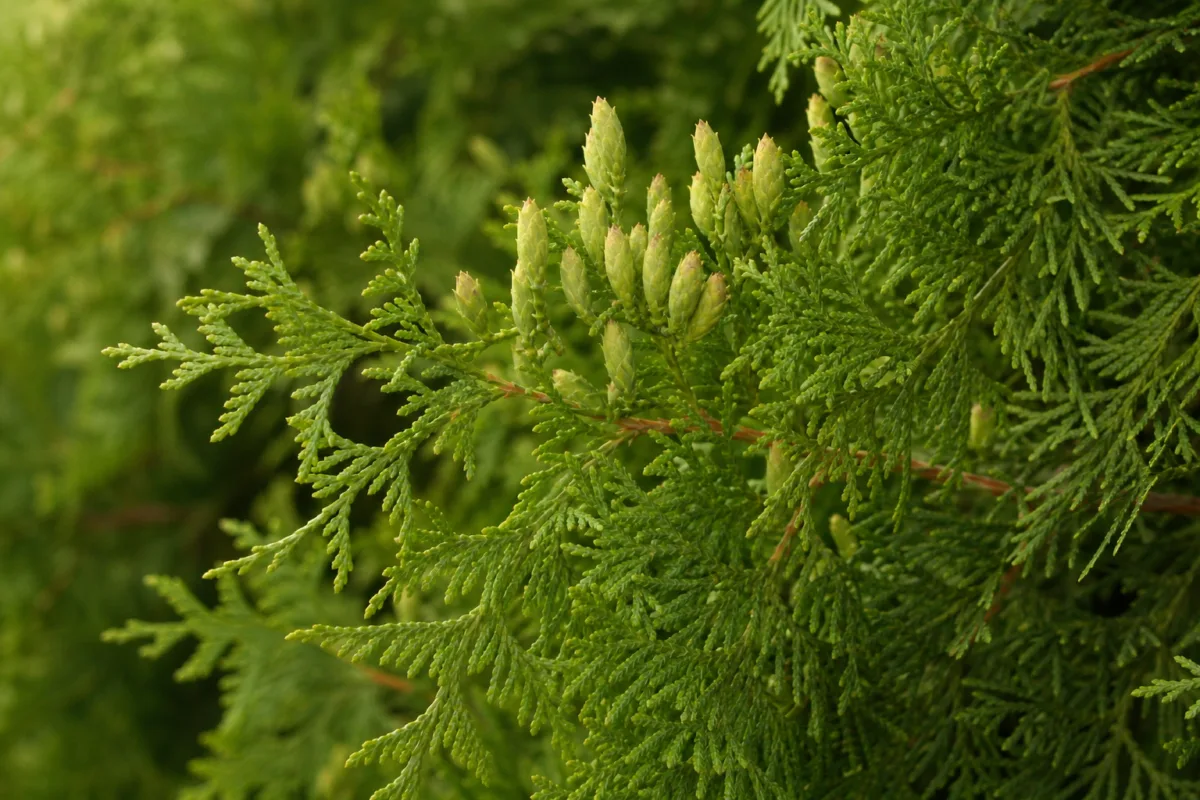
| Leaves / needles | scale-like, appressed, in flattened sprays; aromatic when crushed |
| Flowering | early spring; male and female cones on the same plant |
| Fruit | small upright cone (approx. 8–15 mm), ripens in one season and releases winged seeds |
| Where it grows in the Czech Republic | gardens, hedges, parks, cemeteries, housing estates; rarely naturalised |
| Protection | not native here; commonly cultivated, no special protection |
How to identify arborvitae (Thuja) with confidence
At first glance, arborvitae look like “typical thuja”: dense and finely branched, with flattened fan-like sprays of scale leaves. For reliable separation from similar conifers (especially false cypresses Chamaecyparis and junipers Juniperus), several traits are useful.
- Twigs are distinctly flattened into fan-like sprays and have a lace-like appearance. Many false cypresses also have flattened sprays, but they are often finer and arranged differently.
- The scales bear tiny glands; when crushed they smell resinous to “cedar-like” (especially in Thuja plicata).
- Cones are small and upright, usually with 8–12 scales. This is a practical diagnostic feature when cones are present.
- Bark on older plants is often fibrous and peels in long vertical strips.
An important note on names: the colloquial Czech “tůje” may also refer to Oriental arborvitae, which is now placed outside Thuja as Platycladus orientalis (formerly Thuja orientalis). It often has a different spray and cone shape (cones frequently with noticeable “horns”) and somewhat different tolerance of frost and winter sun.
Thuja species grown in the Czech Republic
The genus Thuja contains only a few species (native to North America and East Asia). In the Czech Republic you will mainly encounter two, often in many cultivars.
Eastern arborvitae (Thuja occidentalis)
The most common “thuja” for hedging. In its native range it grows in eastern North America, often on moister sites. In our conditions it is generally hardy and tolerates pruning well, but it dislikes prolonged drought and heat without watering.
- Size: in gardens often 3–8 m (hedges), tree forms 10–20(25) m.
- Typical cultivars: columnar and conical forms for hedges and specimen planting (very common in practice).
Western redcedar / giant arborvitae (Thuja plicata)
A species from western North America, also known as “western redcedar”. It suits larger gardens and parks because it can grow into more substantial trees than T. occidentalis. The foliage often has a pleasant scent when crushed; it regenerates well after pruning, but like other thujas it suffers in drought and under salt stress.
- Size: in the Czech Republic commonly 15–30(35) m; in hedges, depending on pruning, usually 4–10 m.
- Pros: faster growth and a distinctive fragrance; long-lived in good conditions.
Other species (mostly in collections)
More rarely, arboreta or specialist collections may include Asian species such as Thuja standishii (Japan). In ordinary gardens and hedges, however, these are exceptional.
Where arborvitae grow here and their ecology
In the Czech Republic, Thuja are not native. You’ll find them mainly:
- in hedges around family homes and along property boundaries,
- in park plantings and cemeteries,
- in urban greenery (often as a screen).
Ecologically, it’s worth noting that long single-species thuja hedges generally have lower biodiversity value than mixed hedges made from native shrubs and trees. On the other hand, they do provide year-round cover for some birds and small animals.
Naturalisation of arborvitae in the wider landscape is rather rare here; most cases are chance seedlings near plantings, usually without long-term persistence against competition from native woody species.
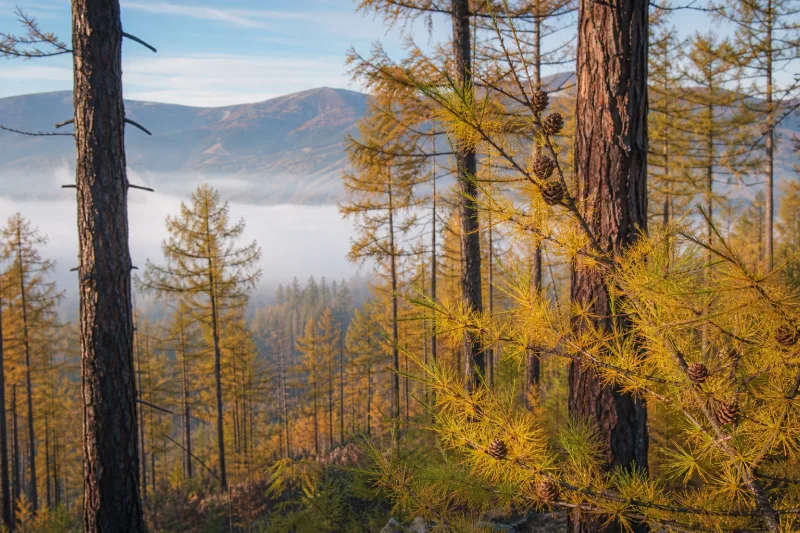
If you’re interested in conifers in general, a broader comparison is in Conifers. For contrast with evergreen arborvitae, you may also find the topic of the deciduous conifer larch useful.
Thuja wood and uses
Thuja wood is typically light and soft, with good natural resistance to decay—especially in Thuja plicata. In North America, T. plicata has major traditional importance (shingles, cladding, fencing, canoes, totem poles). In the Czech Republic arborvitae are grown primarily as ornamentals; the wood is used only marginally (small joinery, interior cladding in dry spaces, garden elements).
The scent and resins can be pleasant to some people and irritating to others. Heavy pruning may cause reactions on sensitive skin—wearing gloves is sensible.
Growing arborvitae in the garden: planting, soil, pruning and care
Arborvitae are popular because they quickly form a continuous green screen. For a hedge to perform well long-term, choosing the right site and not neglecting the first years after planting are key.
Site: light and microclimate
- Light: best in full sun to partial shade. In deeper shade they thin out and become bare inside more readily.
- Wind: a more sheltered position reduces winter desiccation.
- Winter sun: exposed sites can lead to winter “scorch” (a combination of frost, sun and wind).
Soil and watering
- Soil: ideally humus-rich, evenly moist and well drained. Long-term waterlogging promotes root rots.
- pH: slightly acidic to neutral suits them; most cultivars are tolerant.
- Watering: crucial especially in the first 2–3 years and during heat. Less often, but deeply is better than frequent light watering.
- Mulch: a layer of bark or wood chips stabilises moisture and reduces soil overheating.
A common hedge mistake: plants are set into dry fill or a narrow “trench” without improving the soil and without follow-up care. The thuja then survive, but decline inside, thin out and brown.
Planting a hedge: spacing and method
- When to plant: ideally in autumn or spring; container-grown plants can also be planted in season, but only with diligent watering.
- Spacing: roughly 50–80 cm depending on cultivar and how quickly you want the hedge to close. Planting too densely increases disease risk and reduces airflow.
- Root collar: plant at the same depth as in the container; planting too deep increases stress and the risk of rots.
- Watering basin: around young plants helps keep water from running off.
Pruning and shaping: keeping the hedge from going bare
Arborvitae generally do not reshoot well from old wood (sections with no green scales). That’s why it’s important to keep a hedge healthy from the start and prune in a way that preserves green foliage in the interior.
- Timing: most often 1–2× per year (late spring/early summer and, if needed, late summer). Avoid pruning right before frosts.
- Shape: slightly tapered (wider at the bottom, narrower at the top). The lower parts receive more light and won’t thin out as much.
- How hard to cut: don’t cut back into “brown” sections without green scales; the hedge often won’t recover from bare wood.
Fertilising
If the soil is decent and you mulch, a spring top-up with compost is often enough. On poor soils you can use slow-release fertilisers for conifers, but don’t overdo nitrogen—soft growth can be frost-tender and may attract some pests.
Most common problems: browning, dieback, diseases and pests
Thuja browning has many causes. Before reaching for sprays, it’s worth doing simple diagnostics: check watering, salt stress, root damage and planting density—only then consider diseases.
- Drought and overheated soil: the most frequent cause. Shows as gradual dieback of shoot tips, thinning and an overall dull look.
- Winter desiccation and scorch: browning on the side exposed to sun and wind, typically after winter.
- De-icing salt: hedge edges along pavements and roads often fail in a strip; barriers, spring flushing of the soil and choosing more tolerant species outside the salt zone can help.
- Root rots (e.g. Phytophthora): wilting even in wet conditions, partial hedge death; prevention is good drainage and not overwatering.
- Fungal twig dieback (e.g. Kabatina/“twig blight”): local dieback of tips; improving airflow, removing affected parts and boosting plant vigour can help.
- Spider mites and other tiny pests: more common in drought and dusty sites; prevention includes watering and, where feasible, hosing down the foliage during heat.
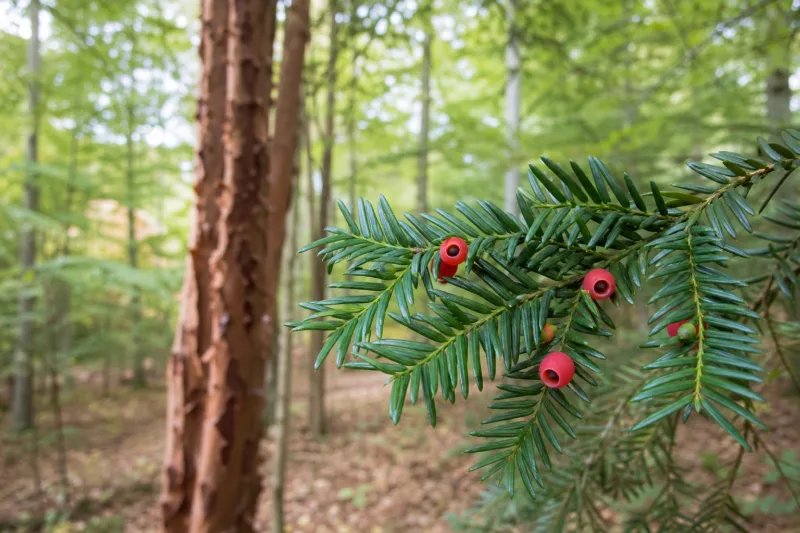
As a more resilient alternative for drier sites, other conifers are sometimes chosen—for example yew (tolerates shade and pruning well, but is poisonous) or some pines (generally more drought-tolerant, but not as straightforward for hedging without thoughtful pruning). For a comparison of conifer cultivation, the article Spruce (Picea) is also useful, as it shows the different requirements of forest conifers.
Interesting facts and cultural context of “thuja”
- “Arborvitae” – the tree of life: Thuja occidentalis acquired the historical name “tree of life” (arbor vitae), partly due to the use of its foliage as a source of vitamin C in the early colonisation of North America.
- The most common mix-up: in horticulture, “thuja” is often confused with false cypresses (Chamaecyparis) or with Oriental arborvitae (Platycladus orientalis). But accurate identification is helpful for care (especially hardiness and response to drought).
- Monoculture hedges: long hedges of a single cultivar are more vulnerable to widespread damage (drought, fungal diseases). In practice, it can pay to mix species—or at least not skimp on spacing and soil care.
Brief summary
Arborvitae (Thuja) are among the most common conifers in Czech gardens—mainly because they quickly form a dense hedge and take shaping well. The most widely grown are Thuja occidentalis and Thuja plicata; both need evenly moist but not waterlogged soil and protection from prolonged drought and salt. If you prune with care (not back into old wood) and keep the root zone in good condition, they will reward you with a long-lived green screen.
FAQ
Is arborvitae (Thuja) native to the Czech Republic?
No. The genus Thuja is native to North America and East Asia; in the Czech Republic it is grown as an ornamental and only rarely becomes naturalised.
What is the difference between “thuja” and Oriental arborvitae?
“Oriental arborvitae” is now botanically <em>Platycladus orientalis</em> and does not belong to the genus Thuja. It has different cones and often responds differently to frost and winter sun.
Why do thujas turn brown on the inside or from the bottom?
It is often a combination of shade inside the hedge, drought, and a shape that is too narrow (the top shades the bottom). A tapered profile, watering in dry spells and avoiding cuts into old wood help.
When should you trim thujas to make them thicken up well?
Most often 1–2 times a year: first in late spring/early summer, and a second time in late summer. Don’t prune late in autumn, and don’t cut deep into sections without green scales.
How far apart should you plant thujas for a hedge?
As a guideline, 50–80 cm depending on the cultivar and the target hedge height. Planting too densely reduces airflow and increases the risk of disease and dieback.
What is worse for thujas: drought or waterlogging?
Both. Prolonged drought leads to dieback and pest pressure, while waterlogging encourages root rots; the ideal is evenly moist but well-drained soil.