Giant sequoia (Sequoiadendron): how to identify and grow it in the Czech Republic
Scientific name: Sequoiadendron
Sequoiadendron is a conifer genus represented by a single species—the giant sequoia. Not native to the Czech Republic, it can still thrive in parks and large gardens, valued for fast growth, exceptional longevity, and a massive trunk with fibrous bark.
 Tomáš Rohlena
8 min read
This article was translated from Czech. Čeština
Sequoiadendron is a conifer genus in the family Cupressaceae (cypress family) with just one living species today: the giant sequoia (Sequoiadendron giganteum). In the Czech Republic it is grown as a park and collection tree—neither invasive nor commonly used in forestry, but in the right conditions it can become an extraordinarily impressive specimen.
For gardeners and tree lovers, it matters as a long-lived landmark tree that needs little to no pruning and is very frost-hardy. The key to success, however, is sufficient moisture, deeper soil, and space—giant sequoia is not a tree for small gardens.
Quick overview: giant sequoia at a glance
| Scientific name | Sequoiadendron giganteum (the only living species in the genus Sequoiadendron) |
|---|---|
| Family (APG IV) | Cupressaceae (cypress family) |
| Height | In its native range typically 50–85 m (exceptionally up to around 95 m); in the Czech Republic and Central Europe usually 20–45 m, and more in excellent conditions |
| Lifespan | Often 1,000–2,000+ years, with maxima over 3,000 years (in its native range) |
| Leaves (needles) | Short, awl-shaped to scale-like, approx. 3–6 mm, evergreen |
| Flowering | Spring; male and female cones on one tree (monoecious) |
| Fruits | Woody cones approx. 4–7 cm, with seeds; cones can persist on branches for many years |
| Typical sites in the Czech Republic | Parks, arboreta, château gardens, larger private properties; mostly in warmer to mildly moist areas |
| Protection status | In the Czech Republic a non-native cultivated taxon, with no special legal protection (individual landmark trees may be protected locally) |
How to identify giant sequoia reliably
At first glance, giant sequoia can resemble other conifers planted in parks, but several features are very characteristic:
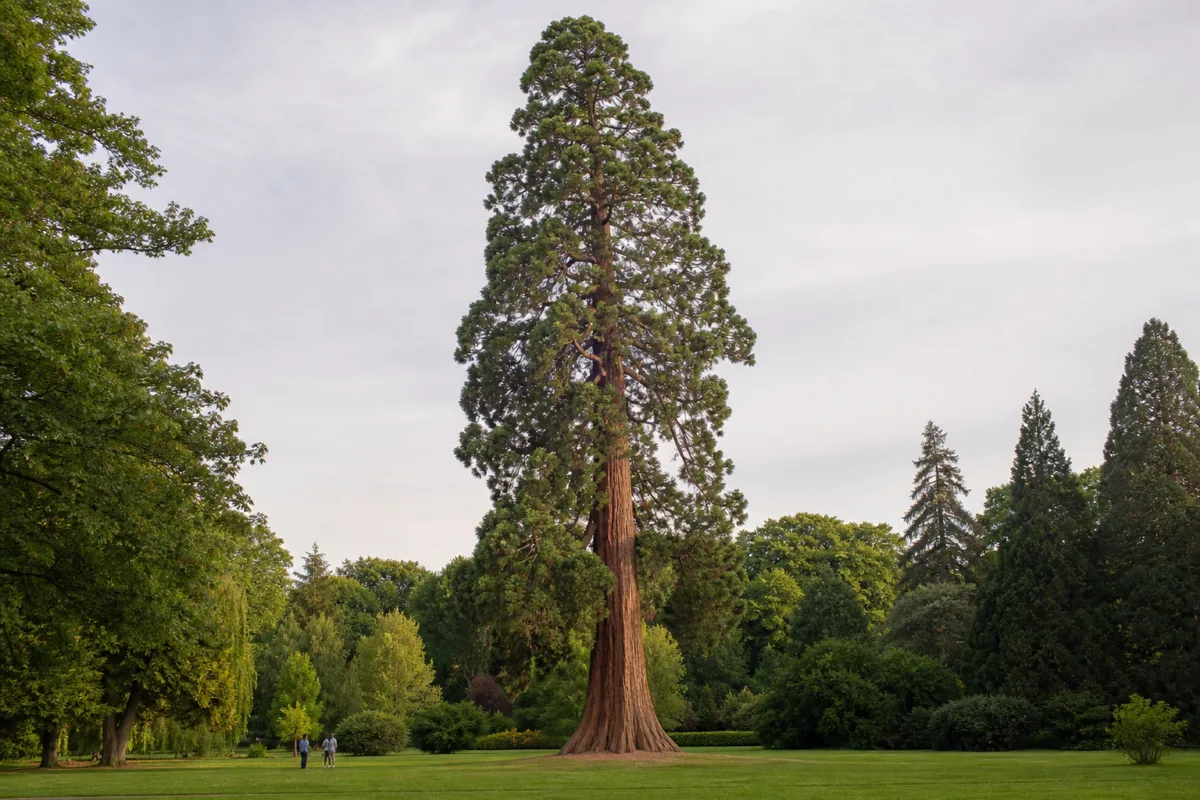
- Bark: very thick, fibrous to “rope-like,” reddish brown. On older trees it feels noticeably softer than spruce or fir bark and is often deeply furrowed.
- Crown: young trees are neatly conical, later broader; branches are fairly stout and carry dense foliage.
- Leaves: tiny, short, awl-shaped to scale-like, pressed close or slightly spreading; twigs can look “bottle-brush” like.
- Cones: small to medium, roundish to egg-shaped, woody (approx. 4–7 cm). They can remain on the tree for a long time, so you often see them outside the season as well.
- Overall impression: a robust, monumental-looking tree with an unexpectedly massive trunk relative to its height (once mature).
If you’re unsure, compare it with common native conifers. Spruce has longer, sharp needles and scaly bark; fir has flat needles and upright cones. Practical conifer overviews can be found in the article Conifers; for comparison, Spruce (Picea) and Fir (Abies) are useful too.
Sequoiadendron species in the Czech Republic: what is actually grown here
The genus Sequoiadendron is currently monotypic, containing only Sequoiadendron giganteum (giant sequoia). In Czech parks and gardens you will therefore encounter essentially only this species, sometimes in the form of cultivars (e.g., more columnar or more compact forms).
In practice, it is sometimes confused with related “sequoia-type” trees—most often Sequoia sempervirens (coast redwood) and Metasequoia glyptostroboides (dawn redwood). Dawn redwood is notable because it sheds its needles in winter (like larch), whereas giant sequoia is evergreen.
Where it grows and what it needs (ecology)
In its native range (California, the Sierra Nevada), giant sequoia grows in mountain areas with snowy winters and a relatively moist water regime—a large share of its annual water comes from snowmelt. This also matches its “European” ecology: it tolerates frost well, but it does not cope with prolonged drought or overheating of the root zone.
In Czech conditions, it does best:
- in parks and arboreta, where it has space and a more stable microclimate,
- in slightly moist to fresh soils, deeper and humus-rich,
- in areas with adequate rainfall or the option of irrigation in the first years.
It generally prefers slightly acidic to neutral soils; on extremely calcareous, dry, and shallow soils growth is weaker and the tree is more prone to drought damage (twig tips drying out, premature shedding of some foliage).
Frost hardiness and wind
Mature trees in the Czech Republic are usually quite frost-hardy (typical winter lows cause no problems). The main risks are late spring frosts on newly flushing shoots and winter desiccation in young plants on exposed, windy sites. When young, a more sheltered position and mulch are worthwhile.
Wood and use: why it isn’t grown as a forestry tree here
In its native range, giant sequoia wood has traditionally been valued for its low weight and relatively good durability, but today the species is protected in the wild and logging from native stands is heavily regulated. In the Czech context, giant sequoia is not grown as a standard forestry tree for several reasons: it needs consistently moister sites over the long term, lots of space, and its “production” value usually doesn’t compete with native species under local conditions.
Its main value here is landscape and collection use: as a park specimen tree, a dendrology teaching example, or a long-term tree for future generations.
Growing giant sequoia in a garden: planting, soil, light, care
Giant sequoia is beautiful—but it’s a “big commitment.” Before planting, picture the tree in 30–60 years: crown spread and root space can be substantial. For small gardens it’s better to choose a different conifer or a very slow-growing cultivar—though even that will thicken and expand over time.
Where to plant it (space and light)
- Light: best in full sun to light partial shade. In shade it becomes sparse and less vigorous.
- Space: assume an adult tree can have a crown many metres across; plant well away from buildings, utilities, and paved surfaces.
- Microclimate: ideally a place sheltered from drying winds, with higher air humidity (e.g., near larger lawns, water features, in a park setting).
Soil and watering
- Soil: deep, well-drained, humus-rich, fresh to moderately moist; avoid shallow, stony soil in full heat.
- Watering: regular after planting (especially the first 2–4 years); during hot periods, water thoroughly but less often (so moisture penetrates deeply). Permanent waterlogging is not desirable either.
- Mulch: a layer of organic mulch (bark, wood chips, leaf mould) stabilises moisture and protects roots from overheating.
Step-by-step planting
- Choose a spot with ample space and the option to water in summer.
- Dig a hole wider than the root ball (not “as deep as possible”; after planting, the root collar should be level with the surrounding ground).
- Loosen the compacted bottom and sides of the planting hole so roots can grow into the surrounding soil.
- Water thoroughly after planting and mulch, but do not pile mulch directly against the trunk.
- For taller nursery trees, consider staking (with posts) for 1–2 seasons.
Pruning and shaping
Giant sequoia is generally not pruned. Only dead or damaged branches are removed (ideally during dormancy). Cutting back the leader or doing “shaping” pruning can cause deformities and increases the risk of infection.
Fertilising
In good soil, intensive feeding is usually unnecessary. If growth is weak and the soil is poor, compost in spring or a modest dose of a slow-release conifer fertiliser can help. Over-fertilising with nitrogen can reduce hardening-off before winter.
Pests and diseases: what to watch for in Czech conditions
In the Czech Republic, giant sequoia is not typically devastated by one signature pest; more common are stress-related issues caused by drought and unsuitable sites.
- Drought and heat: twig tip dieback, thinning foliage, reduced growth. Prevention: mulch, deep watering, proper siting.
- Winter desiccation (especially on young trees): in wind and sun, foliage can turn brown. Watering before winter, mulching, and shelter help.
- Fungal diseases of twigs and foliage: mainly appear when the tree is weakened. Hygiene (removing dead branches), avoid waterlogging, and don’t create overly dense, shady plantings.
- Browsing by wildlife: young trees can be damaged; mesh guards or fencing are often necessary near woodland edges.
Giant sequoia in Czech parks and landscapes: where you can see it
In the Czech Republic, you’ll find giant sequoia mainly as a solitary specimen in historic parks, château gardens, arboreta, and botanical gardens. It was often planted in the 19th and early 20th century as a collector’s rarity, so some examples today have very striking dimensions.
If you enjoy identifying woody plants outdoors, giant sequoia is a rewarding target: even outside the growing season, the bark and cones give it away. And compared with native species, it highlights just how diverse the world of conifers can be (see the overview Conifers).
Interesting facts and cultural significance
- “The biggest” tree in a way other than height: giant sequoia is famous above all for trunk volume—it ranks among the most massive trees on Earth. In height it is usually surpassed by its relative, the coast redwood, but giant sequoia wins on sheer bulk.
- Fire as part of its ecology: in its native range, periodic disturbance (including fire) is one factor supporting regeneration. Thick bark protects the tree, and heat can help cones open and release seeds. In the Czech Republic, of course, we do not imitate this process.
- The cypress family: although older literature used the family “Taxodiaceae,” modern taxonomy (APG IV) places giant sequoia in Cupressaceae, along with many other ornamental conifers.
Brief summary
Sequoiadendron is represented here by a single species, the giant sequoia, grown mainly in parks and larger gardens. You can recognise it by its massive trunk, thick fibrous bark, and woody cones. For successful cultivation in the Czech Republic, adequate moisture, deeper soil, and space are crucial; pruning is rarely needed.
If you’d like to compare it with common native conifers, also open the overview Conifers and the articles Fir (Abies), Spruce (Picea), or Pine (Pinus).
FAQ
Is giant sequoia native to the Czech Republic?
No. Giant sequoia (<em>Sequoiadendron giganteum</em>) is native to California and is grown in the Czech Republic as an ornamental and collection tree.
How fast does giant sequoia grow in Czech conditions?
When young, it can grow quite quickly if it has enough moisture, but the overall rate depends strongly on soil and watering. In drought and on shallow soils it slows down markedly.
Is giant sequoia suitable for a small garden?
Usually not. It needs a large root zone and plenty of room for the crown; in smaller gardens it’s better to choose smaller conifers or very compact cultivars.
Can giant sequoia withstand frost in the Czech Republic?
Mature trees generally can and are usually quite frost-hardy. The bigger risks are spring frosts and winter desiccation in young plantings on exposed sites.
Why do the tips of giant sequoia branches turn brown?
Most often the cause is drought (including winter desiccation) or overheating of the roots on an unsuitable site. Mulching, deeper watering, and a more sheltered position help.
Can giant sequoia be shaped by pruning?
It isn’t recommended. Giant sequoia is usually not pruned; only dead or damaged branches are removed, because heavier cuts can deform and weaken the tree.